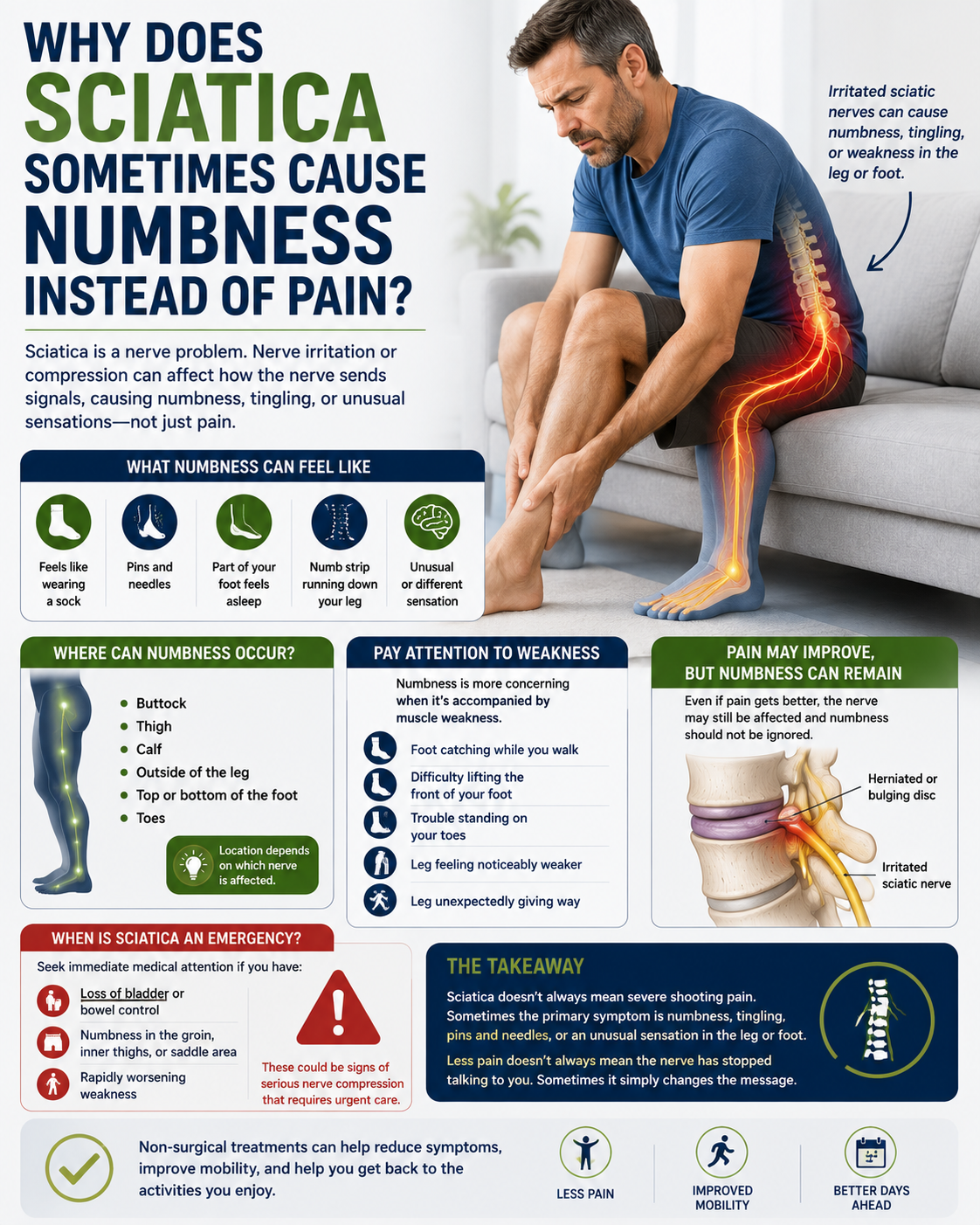
When most people think about sciatica, they picture:
⚡ Sharp pain shooting down the leg.
🔥 Burning in the buttock or thigh.
But sometimes sciatica doesn't hurt very much at all.
Instead...
👉 Your foot feels numb.
👉 Part of your calf feels strange.
👉 You have pins and needles running down your leg.
And that can leave you wondering:
“How can I have sciatica if I'm not really in pain?”
Sciatica refers to symptoms caused by irritation or compression of nerves that contribute to the sciatic nerve.
Those nerves don't only transmit pain signals.
They also carry information related to:
That's why nerve irritation can produce several different symptoms, not just pain.
People describe it in many different ways:
🦶 “Part of my foot feels asleep.”
🧦 “It feels like I'm wearing a sock even when I'm barefoot.”
🐜 “I have pins and needles.”
🦵 “There's a numb strip running down my leg.”
Others describe an unusual sensation that's difficult to explain but clearly feels different from the opposite leg.
The location depends partly on which nerve is affected.
Symptoms may occur in the:
Some people experience pain in one area and numbness somewhere else.
This can be confusing.
You might think:
👉 “My back and leg don't hurt anymore, so I must be better.”
But persistent numbness means the nerve may still be affected.
Pain improving is encouraging, but numbness shouldn't automatically be ignored simply because the discomfort has decreased.
Numbness becomes more concerning when it's accompanied by muscle weakness.
You might notice:
🚩 Your foot catching while you walk
🚩 Difficulty lifting the front of your foot
🚩 Trouble standing on your toes
🚩 One leg feeling noticeably weaker
🚩 Your leg unexpectedly giving way
New or worsening weakness deserves prompt medical evaluation.
Nerves can sometimes recover slowly after irritation or compression improves.
However, prolonged or significant nerve compression can potentially result in lasting sensory or motor changes.
That's one reason persistent or worsening numbness shouldn't simply be ignored.
Seek urgent medical attention if numbness occurs along with:
🚨 Loss of bladder or bowel control
🚨 Numbness around the groin, inner thighs, or saddle area
🚨 Rapidly worsening weakness
These can indicate serious nerve compression requiring immediate evaluation.
Sciatica doesn't always mean severe shooting pain.
Sometimes the primary symptom is:
👉 Numbness.
👉 Tingling.
👉 Pins and needles.
👉 An unusual sensation in the leg or foot.
And even if the pain improves, persistent numbness may indicate that a nerve is still being affected.
At our Arthritis & Joint Pain Centers, we help appropriate patients with chronic back and sciatic symptoms explore non-surgical treatment options, with the goal of reducing symptoms and improving mobility.
👉 Less pain doesn't always mean the nerve has stopped talking to you. Sometimes it simply changes the message.