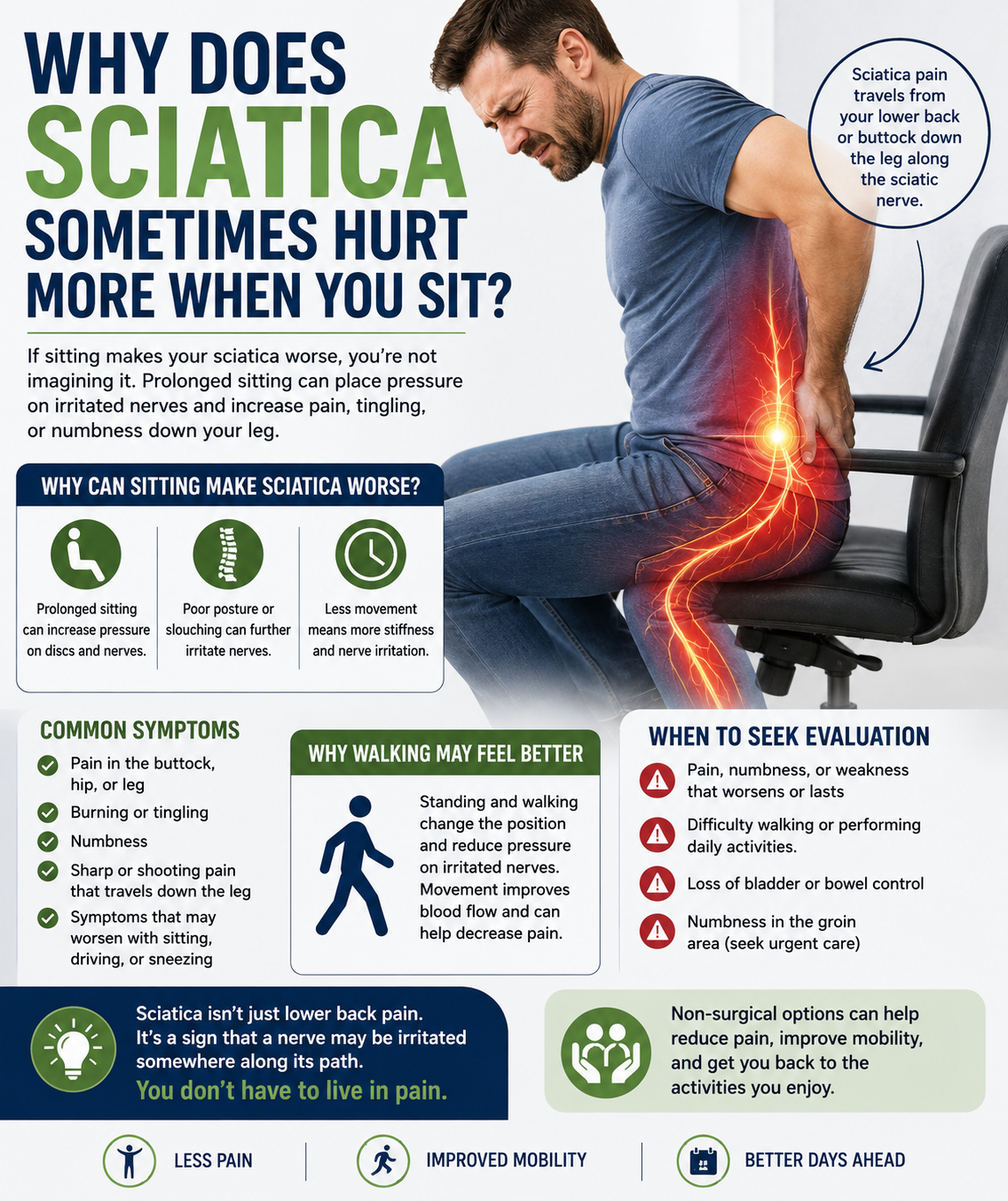
You sit down to relax...
And instead of feeling better, the pain starts.
👉 Your buttock begins aching.
👉 Burning travels down your thigh.
👉 Your leg starts tingling.
Then you stand up and walk around...
And sometimes it actually feels better.
For many people with sciatica, sitting can be one of the most uncomfortable positions.
Sciatica describes symptoms caused by irritation or compression of nerves that contribute to the sciatic nerve.
These nerves originate in the lower back and travel into the buttock and leg.
Depending on what's causing the irritation, prolonged sitting can change the position and loading of structures in the lower back and aggravate an already sensitive nerve.
Many people with sciatic pain struggle most in the car.
Think about the position you're in while driving:
🚗 Hips bent
🦵 Legs positioned forward
🪑 Lower back supported in one position
⏰ Very little movement for extended periods
After 30 minutes or an hour, you may notice pain beginning to travel farther down your leg.
Then you get out of the car...
Walk around...
And the symptoms may gradually decrease.
Sciatica isn't simply lower back pain.
An irritated nerve can produce symptoms anywhere along its pathway.
You may feel:
Some people actually experience very little back pain.
Their primary complaint is:
👉 “The pain is all in my leg.”
Changing positions can alter the stress placed on irritated structures.
Standing and walking also gets you out of the prolonged seated position that may have been aggravating your symptoms.
That's why some people find themselves constantly switching between:
Sit → Stand → Walk → Sit
They're simply trying to find the position that irritates the nerve the least.
No.
Sciatic symptoms can have different underlying causes, including problems involving:
And this is important:
👉 Not everyone's symptoms behave the same way.
Some people feel worse sitting.
Others actually feel worse standing or walking.
How your symptoms respond to different positions can provide useful information when determining what may be contributing to the problem.
Consider having persistent symptoms evaluated if:
🚩 Pain repeatedly travels down the leg
🚩 Numbness or tingling is becoming more frequent
🚩 Symptoms are interfering with sleep or daily activities
🚩 You're having difficulty walking or performing normal activities
New or progressively worsening muscle weakness deserves prompt medical evaluation.
Loss of bladder or bowel control or numbness around the groin or saddle area requires urgent medical attention.
If sitting makes your sciatica worse, you're not imagining it.
Prolonged sitting can aggravate certain causes of nerve irritation and make symptoms travel from the lower back or buttock into the leg.
And sometimes simply changing position provides temporary relief.
At Buffalo Arthritis & Joint Pain Center, we help appropriate patients with chronic back and sciatic pain explore non-surgical treatment options, with the goal of reducing pain and improving mobility.
👉 If you can't sit comfortably without pain shooting down your leg, it's worth understanding why.