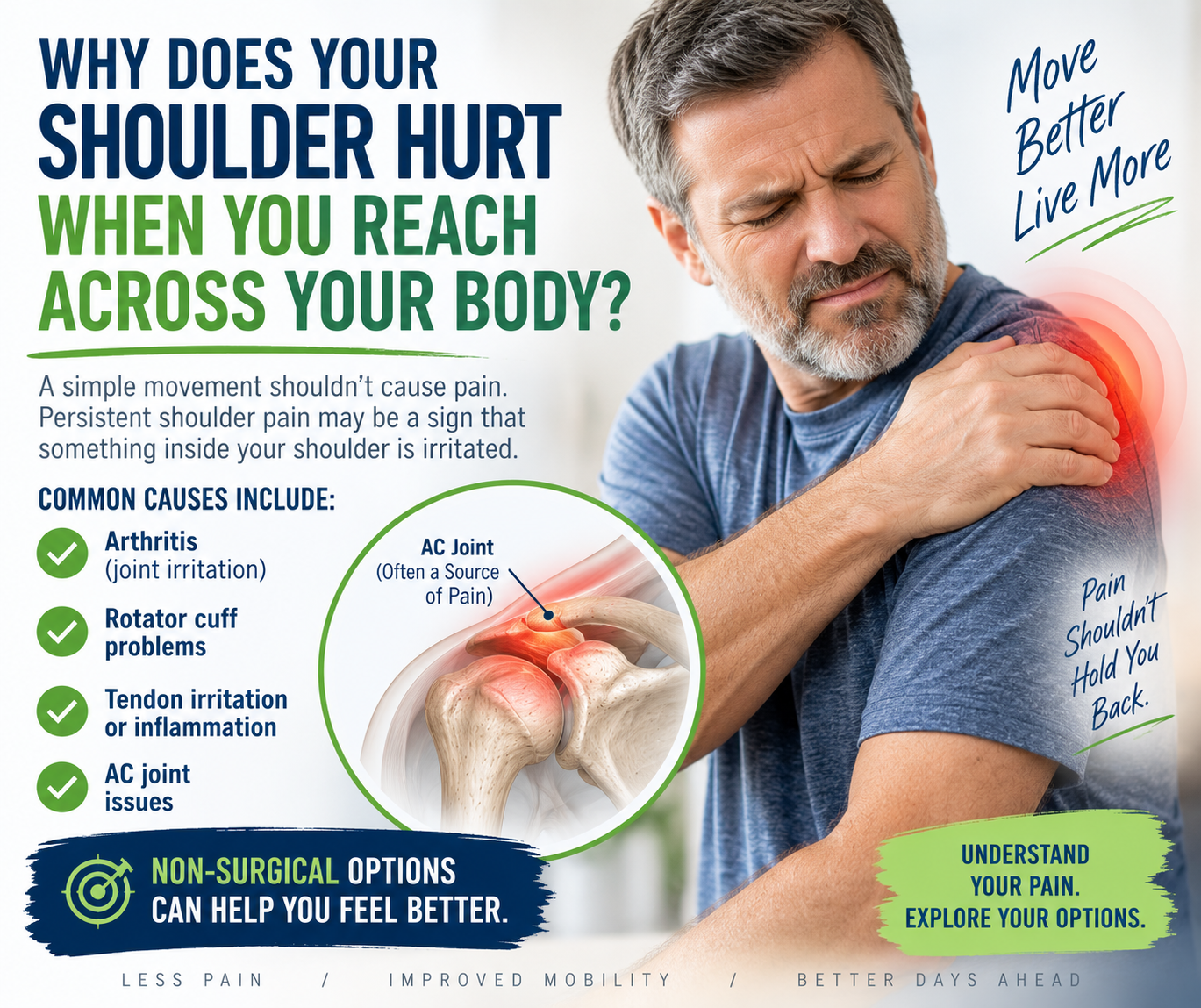
You reach across your chest to grab the seatbelt...
Wash the opposite shoulder...
Or reach for something on the other side of the table...
And suddenly:
👉 Your shoulder hurts.
Pain when reaching across your body is a common shoulder complaint, but many people aren't sure why such a simple movement causes discomfort.
Reaching across your chest requires several parts of your shoulder to move together.
The movement places stress on structures around the:
If one of these areas is irritated, reaching across your body may quickly expose the problem.
The location of your pain may provide clues.
If you feel pain directly on top of your shoulder, the AC joint may be involved.
This small joint is where your collarbone meets part of your shoulder blade.
Arthritis and irritation in this joint can make reaching across your chest particularly uncomfortable.
A deeper ache may be associated with other structures within or surrounding the shoulder joint.
You may also notice discomfort when:
🙋 Reaching overhead
👕 Getting dressed
🚗 Reaching for a seatbelt
🛏️ Sleeping on that shoulder
You may feel relatively good while you're active...
But later that evening your shoulder begins aching.
Activities involving repetitive reaching, lifting, pushing, or pulling can irritate sensitive shoulder structures.
Once you stop moving and the shoulder cools down, the discomfort may become more noticeable.
Without even realizing it, you may begin adapting.
Instead of reaching normally, you:
👉 Turn your entire body.
👉 Use your opposite arm.
👉 Keep your elbow close to your side.
👉 Avoid reaching altogether.
These little changes can gradually become part of your everyday routine.
Not necessarily.
People often assume persistent shoulder pain means they have torn their rotator cuff.
But pain reaching across your body can have several possible causes, including:
That's why determining the source of the pain matters.
Consider having persistent shoulder pain evaluated if:
🚩 It lasts for several weeks
🚩 Your range of motion is decreasing
🚩 You develop noticeable weakness
🚩 Pain regularly wakes you at night
🚩 Everyday activities are becoming difficult
Sudden severe pain or weakness after an injury also deserves medical evaluation.
Reaching across your body seems like a simple movement—until your shoulder begins hurting every time you do it.
Persistent pain may be a sign that something within or around the shoulder is irritated and isn't moving as comfortably as it should.
At Buffalo Arthritis & Joint Pain Center, we help patients with chronic shoulder pain explore non-surgical treatment options when appropriate, with the goal of reducing pain and improving mobility.
👉 If you've started changing how you move because of your shoulder, it may be time to understand why.