It seems like such a simple task.
You sit down in the morning...
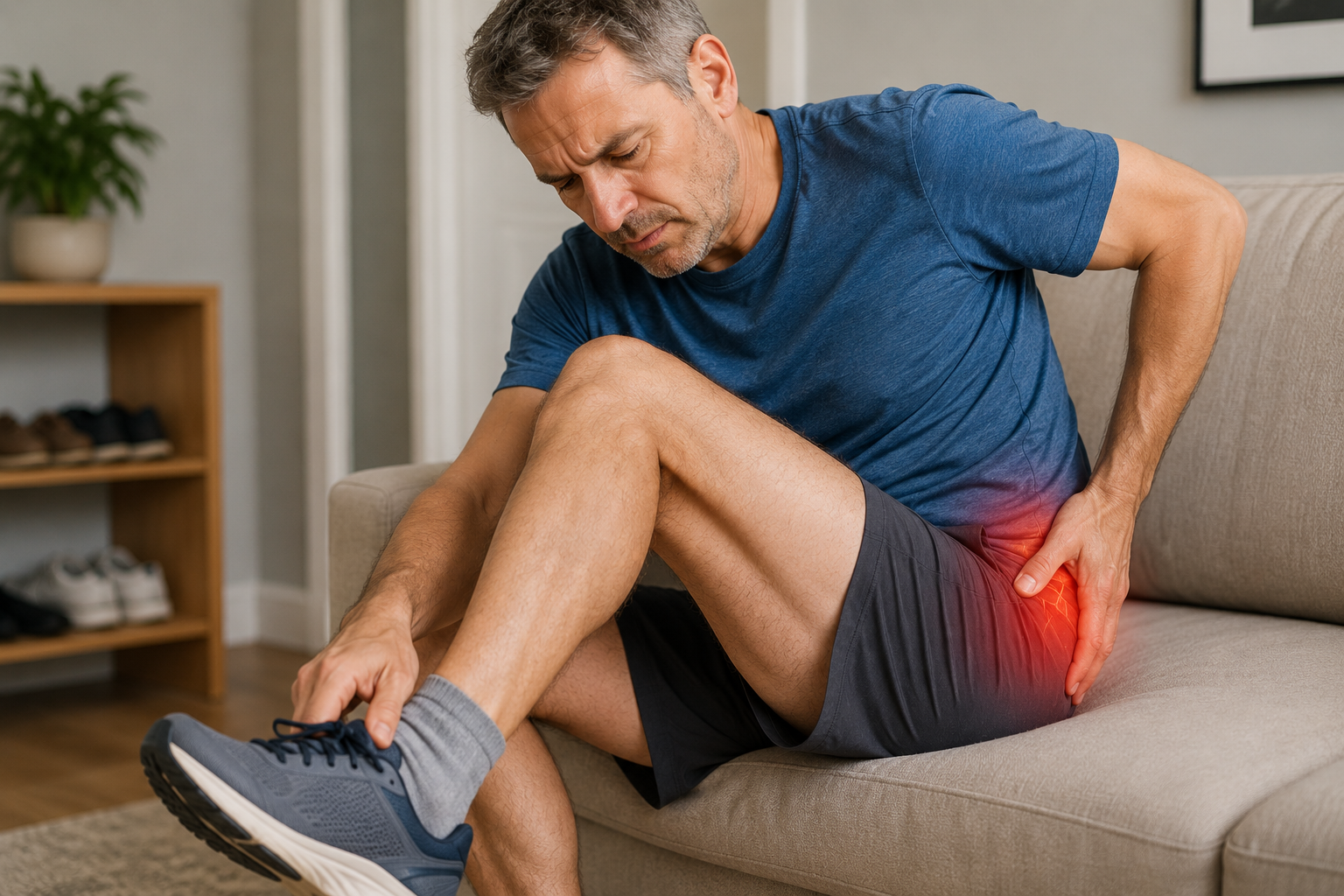
Reach toward your foot to put on a sock...
And suddenly:
👉 Your hip won't cooperate.
Maybe you have pain in the groin.
Maybe your hip feels incredibly stiff.
Or perhaps you've started finding creative ways to get dressed without bending your hip very much at all.
Difficulty putting on shoes and socks is a surprisingly common complaint among people with chronic hip problems.
Putting on a shoe or sock requires more hip mobility than you might realize.
Your hip has to:
When the hip becomes painful or stiff, combining these movements can become difficult.
Hip problems don't always hurt directly on the outside of the hip.
Many people with problems involving the hip joint actually experience pain in the:
👉 Groin
👉 Front of the thigh
👉 Upper thigh
👉 Buttock
Some people even experience discomfort that seems to travel toward the knee.
That's why it isn't always obvious that the hip is the source of the problem.
Hip arthritis can gradually affect how comfortably the joint moves.
You may first notice difficulty with activities like:
👟 Putting on shoes
🧦 Pulling on socks
🚗 Getting in and out of the car
🪑 Standing after sitting
🛏️ Getting out of bed
At first, you simply work around it.
Over time, those little adjustments can become your new routine.
Maybe you:
👉 Bring your foot toward you instead of bending forward.
👉 Put your foot on a chair.
👉 Buy slip-on shoes.
👉 Ask your spouse for help.
👉 Stop wearing certain shoes altogether.
People can become remarkably good at adapting to a painful hip.
The problem is that sometimes you don't realize how much mobility you've lost until everyday tasks become difficult.
People with chronic hip problems commonly notice stiffness after periods of inactivity.
You may sit through dinner or watch television...
Then stand up and need several steps before the hip begins moving comfortably again.
That combination of pain plus stiffness can make bending and rotating the hip especially challenging.
No.
Having chronic hip pain or even hip arthritis doesn't automatically mean you're ready for joint replacement.
The appropriate treatment depends on factors such as:
For some people, surgery eventually becomes appropriate.
Others may be candidates for conservative or non-surgical approaches.
Consider an evaluation if:
🚩 Hip or groin pain persists for several weeks
🚩 You're progressively losing mobility
🚩 You regularly limp
🚩 Pain wakes you at night
🚩 Everyday activities like shoes, socks, stairs, or getting into a car are becoming difficult
Sudden severe hip pain or inability to bear weight, particularly after a fall or injury, deserves prompt medical evaluation.
Sometimes chronic hip problems don't announce themselves with dramatic pain.
Instead, you slowly realize:
“I can't move the way I used to.”
And something as ordinary as putting on your shoes and socks becomes a daily reminder.
At our Arthritis & Joint Pain Centers, we help appropriate patients with chronic hip pain explore non-surgical treatment options, with the goal of reducing pain and improving mobility.
👉 When everyday movements start becoming workarounds, it may be time to find out what's happening with your hip.