Opening a jar.
Turning a key.
Twisting a doorknob.
Holding a coffee mug.
Even pulling open a stubborn package.
They seem like simple movements, until you develop pain at the base of your thumb.
Then suddenly, everyday tasks can make you wince.
If you've noticed yourself using your other hand more often or asking someone else to open things for you, there may be a reason.
Your thumb does an incredible amount of work.
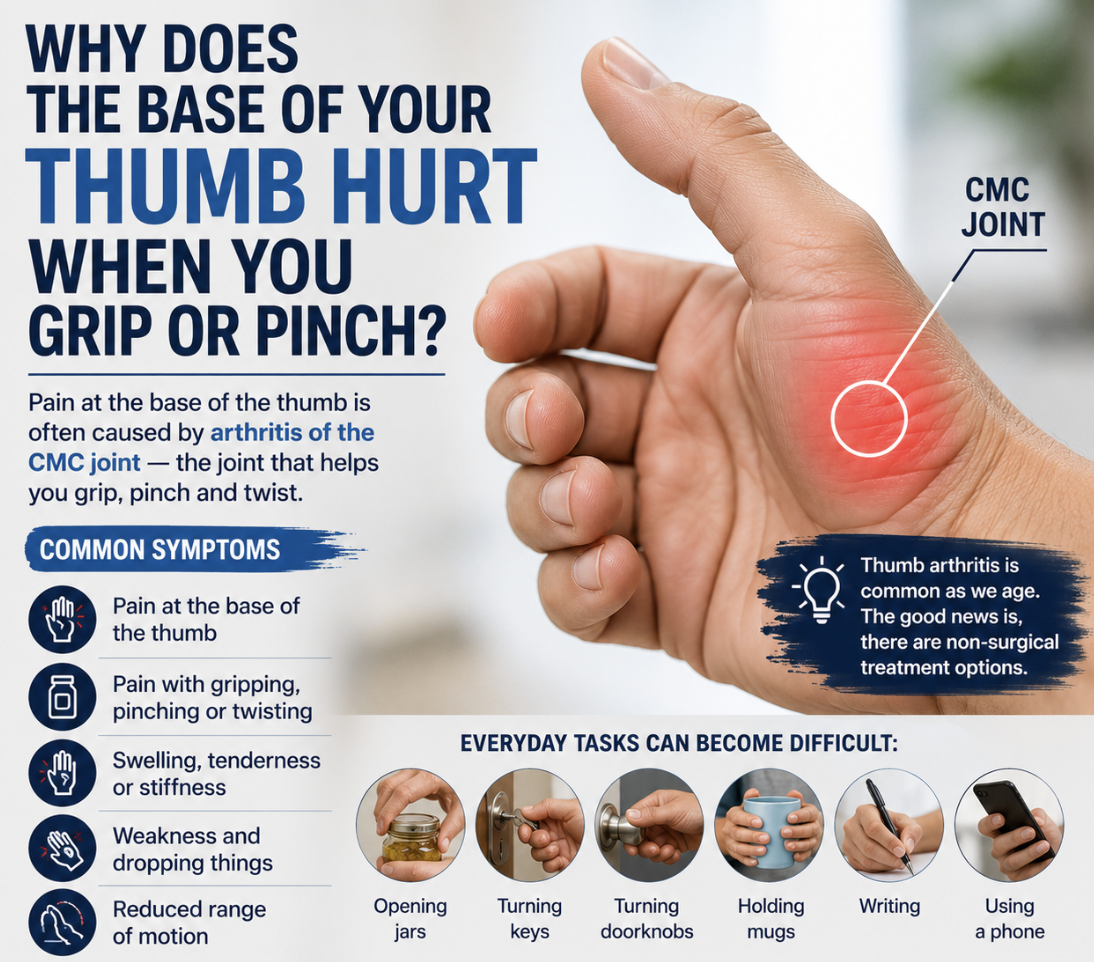
At its base is a joint called the carpometacarpal joint or CMC joint.
This joint allows your thumb to move in multiple directions so you can grip, pinch, twist and grasp objects.
Unfortunately, that mobility also means the joint gets used constantly.
And as we age, the cartilage inside the joint can begin to wear down.
Thumb arthritis is especially common as people get older.
Think about opening a tight jar.
Your fingers wrap around the lid while your thumb presses firmly against it.
That creates significant force through the base of the thumb.
If the CMC joint is irritated or arthritic, movements involving gripping, pinching or twisting can become particularly painful.
That's why people often first notice the problem doing things like:
🫙 Opening jars
🔑 Turning keys
🚪 Turning doorknobs
☕ Holding mugs
✍️ Writing
📱 Holding or using a phone
👕 Buttoning clothing
The pain is typically located near the base of the thumb where it meets the wrist.
You may notice:
👉 Aching at the base of the thumb
👉 Tenderness when you press on the area
👉 Swelling
👉 Stiffness
👉 Weakness when gripping
👉 Difficulty pinching objects
👉 Reduced thumb movement
Some people eventually notice that the joint itself looks larger or develops a bump.
This is another complaint people don't always connect with their thumb.
You pick up a glass.
Grab a plate.
Carry a grocery bag.
And suddenly your grip doesn't feel as strong as it used to.
Thumb arthritis can reduce grip and pinch strength, making certain objects harder to hold securely.
Sometimes it's weakness.
Other times you may subconsciously release your grip because squeezing harder hurts.
No.
Pain around the thumb and wrist can have several causes.
Tendon problems, previous injuries, nerve conditions and other joint problems can produce symptoms in a similar area.
That's why persistent pain shouldn't automatically be diagnosed as arthritis based solely on where it hurts.
No.
Many cases can initially be managed without surgery.
Depending on the individual, treatment may include modifying aggravating activities, splinting, ice or heat, medication and other conservative approaches. Surgery is generally one of several potential options rather than an automatic next step.
Consider having your hand evaluated if:
🚩 Pain isn't going away
🚩 Your grip is becoming noticeably weaker
🚩 The joint repeatedly swells
🚩 You're losing thumb movement
🚩 Everyday activities are becoming increasingly difficult
Sudden severe pain following an injury, significant swelling, redness or other rapidly developing symptoms should also be evaluated.
Sometimes arthritis doesn't announce itself with dramatic pain.
Instead, you realize:
“I can't open jars anymore.”
Or:
“Why does turning this key hurt so much?”
Those little changes in everyday life can be important clues.
At Arthritis & Joint Pain Center, we help appropriate patients with chronic joint pain explore non-surgical treatment options, with the goal of reducing pain and improving function.
Your thumb may be small, but when it hurts, you realize just how much you use it.