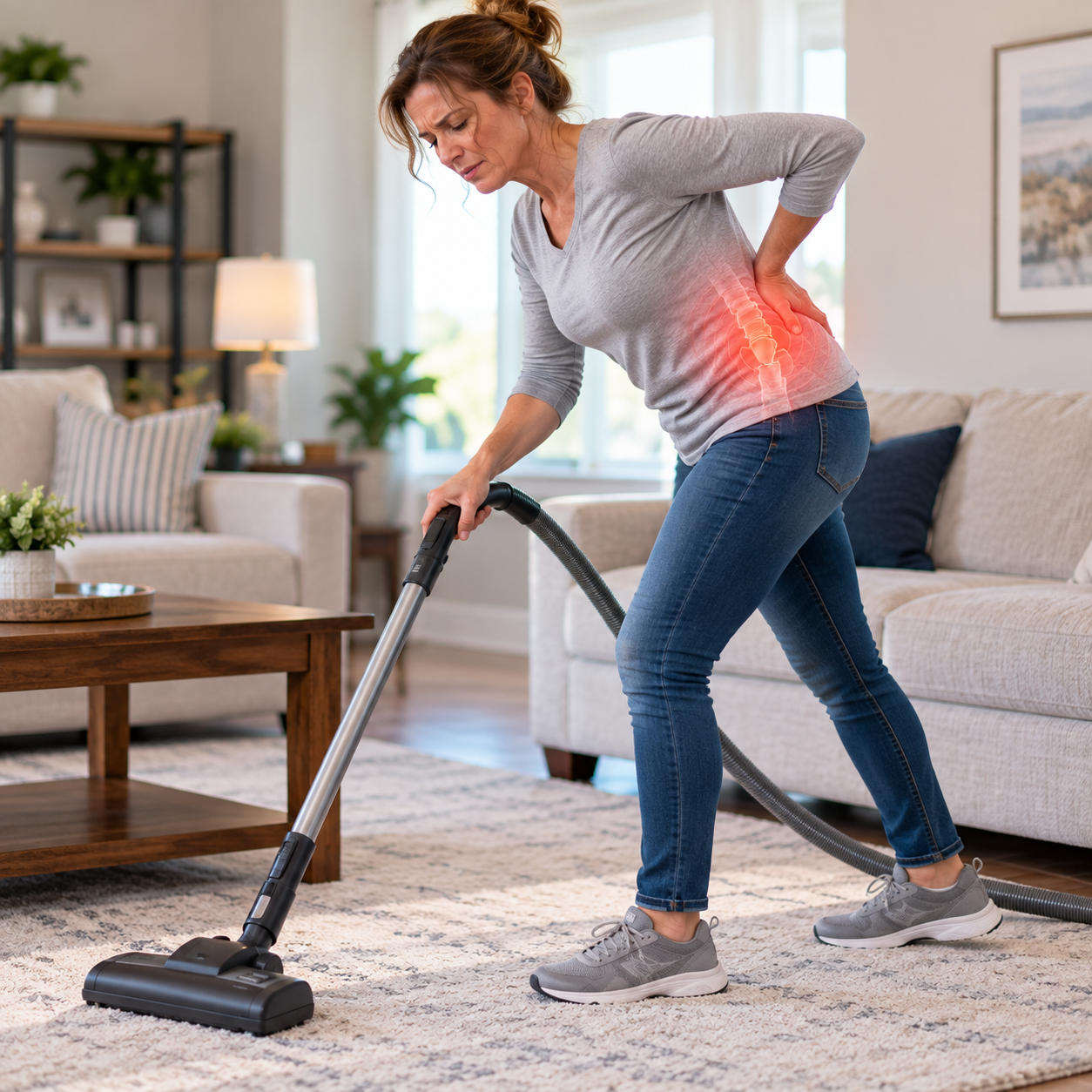
You start vacuuming the living room.
Five minutes later, your lower back starts aching.
You straighten up for a few seconds and it feels a little better.
Then you bend forward, push the vacuum again and the discomfort returns.
Sound familiar?
Vacuuming and sweeping don't look like strenuous activities, but they combine several movements that can aggravate an already sensitive lower back.
Think about what your body is actually doing.
You're repeatedly:
🧹 Bending slightly forward
↔️ Reaching away from your body
🔄 Twisting from side to side
🚶 Taking short, uneven steps
💪 Pushing and pulling with one arm
Instead of your spine staying relatively neutral, you're often bending, rotating and reaching at the same time.
For someone with an irritated or stiff lower back, that combination can become uncomfortable surprisingly quickly.
Many people vacuum with the handle too far in front of them.
That causes the upper body to lean forward.
The farther your torso moves away from an upright position, the harder the muscles around your lower back have to work to support you.
Doing it once isn't usually a big deal.
But repeating that position for 10, 20 or 30 minutes can cause the muscles to fatigue and may aggravate sensitive structures in the lower back.
Sometimes it's not simply bending that bothers the back.
It's bending and twisting together.
Imagine vacuuming around a couch.
Your feet stay planted while your upper body rotates to move the vacuum beside or behind the furniture.
Then you rotate the opposite direction.
Repeated twisting can irritate an already sensitive back, particularly if you have reduced mobility or arthritis.
A better strategy is often to move your feet and turn your entire body instead of repeatedly twisting through your lower back.
Yes.
Arthritis in the small joints of the spine called the facet joints can contribute to lower-back pain and stiffness.
Someone with lumbar arthritis might notice discomfort during:
🧹 Housework
🍳 Standing at the kitchen counter
🌱 Gardening
🛒 Shopping
🚶 Longer periods of standing or walking
🛏️ Getting out of bed in the morning
But arthritis isn't the only possible cause.
The discs between the vertebrae help absorb forces through the spine.
Certain disc problems can make repeated bending uncomfortable.
If a disc or another structure irritates a nearby nerve, symptoms may extend beyond the back.
You might experience:
⚡ Shooting pain into the buttock or leg
🔥 Burning
🐜 Tingling
🦶 Numbness
🦵 Weakness
Those symptoms deserve more attention than simple temporary muscle fatigue.
After several minutes of vacuuming, you may notice yourself stopping and putting your hands on your hips while you stand upright.
That change of position gives the muscles that were holding you forward a break.
But there's an important distinction.
Some back conditions feel better when you stand upright, while others may actually feel better when you bend forward.
For example, people with lumbar spinal stenosis sometimes feel better leaning slightly forward—one reason leaning over a shopping cart can provide relief.
That's why the movements that increase and decrease your symptoms can provide useful clues about what's happening.
A few simple changes may reduce unnecessary stress on your back.
Try:
Keep the vacuum closer to you.
Avoid reaching several feet forward with each stroke.
Take smaller steps.
Move with the vacuum instead of repeatedly reaching.
Turn with your feet.
Rather than planting your feet and twisting your spine, reposition your whole body.
Switch hands occasionally.
This may help prevent repeatedly loading your body in the same direction.
Take short breaks.
Twenty or thirty straight minutes of repetitive bending may be much different from several shorter periods.
And don't try to move heavy furniture with one hand while vacuuming with the other.
There's a difference between feeling mildly tired after housework and experiencing pain that repeatedly limits what you can do.
Maybe you used to vacuum the entire house at once.
Now you do one room and sit down.
Or perhaps you've started asking someone else to vacuum because you know what your back will feel like afterward.
Those changes matter.
Declining function is often just as important as the pain itself.
No.
Back pain during vacuuming or sweeping doesn't automatically mean you have a serious spinal problem or need surgery.
Muscle fatigue, arthritis, reduced mobility, disc problems and nerve irritation can all contribute to back pain.
The important question is why your back is hurting and what activities consistently trigger it.
Depending on the cause, there may be non-surgical approaches that can help reduce symptoms and improve function.
Consider an evaluation if your back pain is becoming more frequent, your ability to stand or walk is decreasing, pain repeatedly travels into your leg, or you're developing numbness, tingling or weakness.
Seek urgent medical attention for symptoms such as new loss of bowel or bladder control, numbness around the groin or saddle area, or rapidly worsening leg weakness.
If vacuuming or sweeping has become something you dread because you know your back will hurt afterward, don't simply assume it's because you're getting older.
Pay attention to the pattern.
The bending, reaching, twisting and prolonged standing involved in housework may be exposing an underlying back problem that isn't as noticeable during other activities.
At Arthritis & Joint Pain Center, we help appropriate patients with chronic back pain understand what's contributing to their symptoms and explore non-surgical treatment options, with the goal of reducing pain and improving function.
Because cleaning the house shouldn't put you out of commission for the rest of the day.