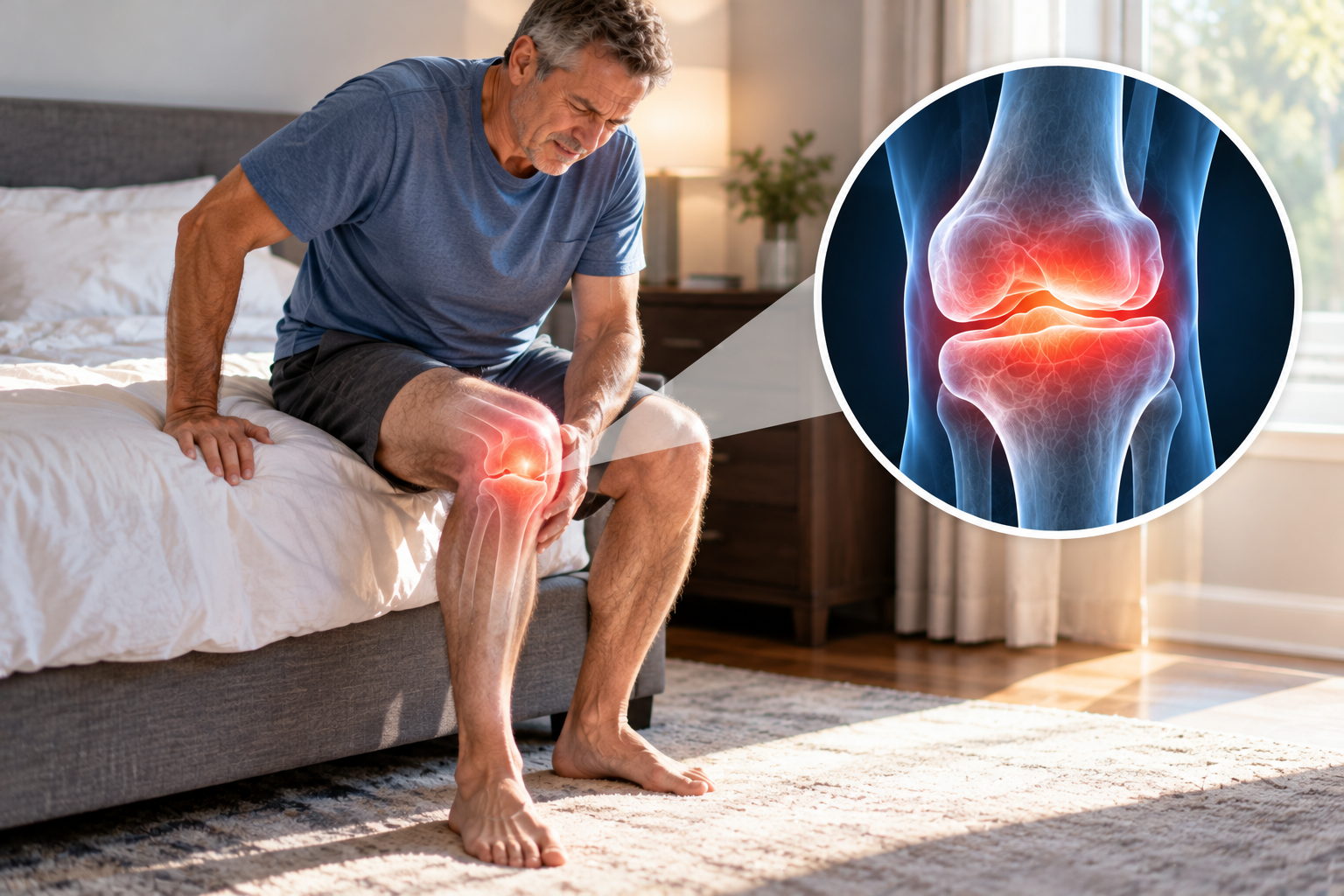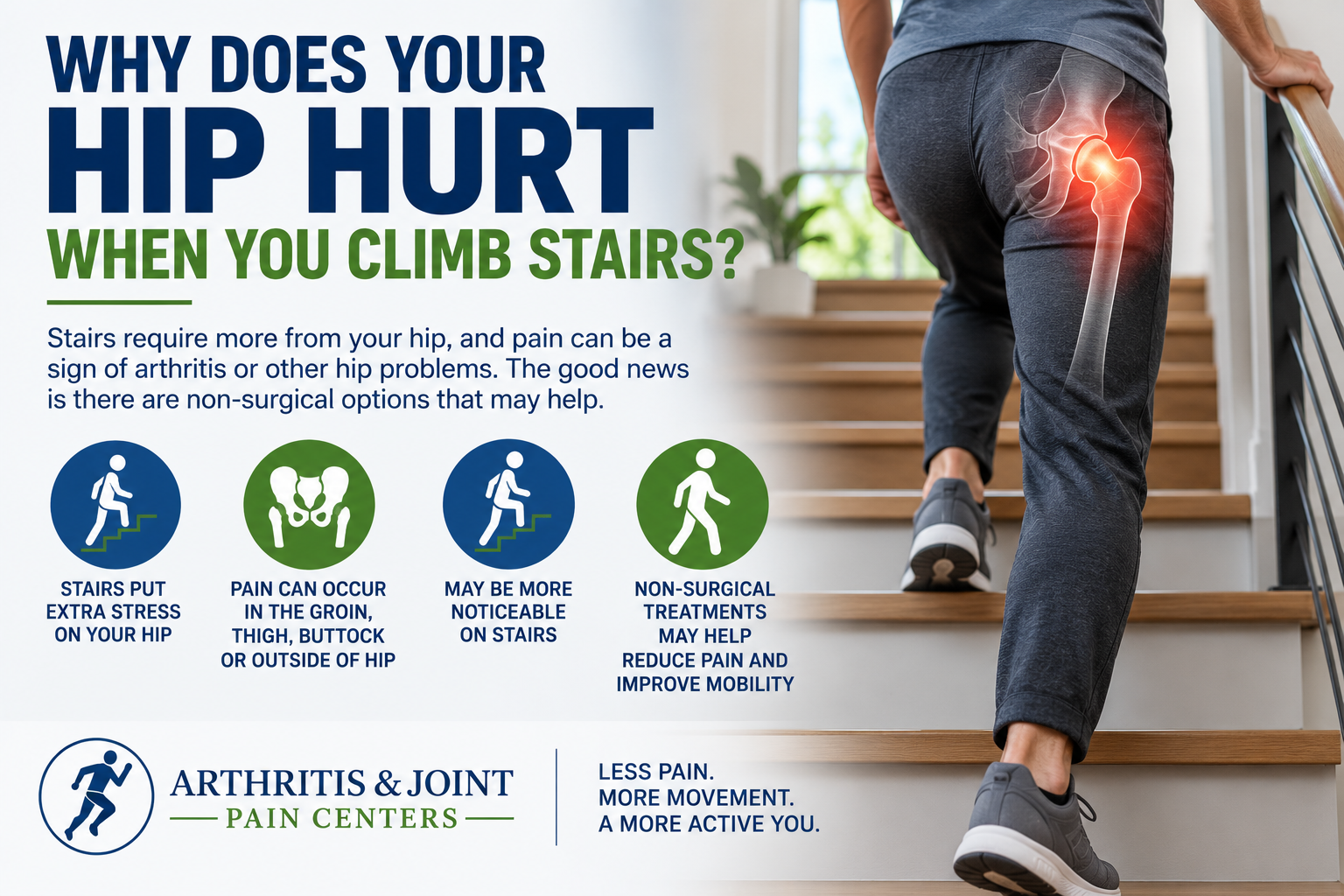
Walking across a flat room isn't too bad.
Then you reach the stairs.
You put one foot on the first step, push yourself upward and—
There it is.
That familiar pain in your hip.
Maybe you feel it in your groin.
Maybe it's on the outside of your hip.
Or perhaps it travels into your upper thigh.
And you've started wondering:
“Why are stairs so much harder on my hip than regular walking?”
There's a good reason.
Your hip is one of the largest weight-bearing joints in your body.
During normal walking, it helps support your weight and move your leg with every step.
But climbing stairs requires considerably more from the muscles surrounding the hip than level walking. Research measuring hip muscle activity has found greater demands during stair climbing, particularly as you lift and propel your body onto the next step.
If the joint is arthritic, stiff or irritated, those increased demands can make symptoms much more noticeable.
This can be confusing.
Many people assume hip arthritis should hurt directly over the outside of the hip.
But pain from the hip joint is commonly felt in the groin.
It may also be experienced in the:
👉 Front of the hip
👉 Upper thigh
👉 Buttock
👉 Outside of the hip
👉 Knee
Hip osteoarthritis can also cause stiffness and decreased range of motion, which can make everyday activities progressively more difficult.
Pay attention to how you use stairs.
Have you started:
🪜 Leading with the same leg every time?
🦵 Bringing both feet onto each step before continuing?
🤚 Pulling yourself upward using the railing?
↗️ Turning your body slightly sideways?
🚫 Avoiding stairs whenever there's an elevator?
You might not have consciously decided to do any of those things.
Your body simply discovered a way to make the movement hurt less.
Imagine sitting on the couch for an hour and then immediately climbing a staircase.
Your hip has been relatively still.
Now you're asking it to bend, stabilize your pelvis, support your weight and generate enough force to lift your body onto the next step.
If your hip is stiff after inactivity, that transition can be particularly uncomfortable.
Osteoarthritis commonly causes stiffness after periods of rest or inactivity.
That's why someone might say:
“Once I get moving I'm not terrible—but getting started is tough.”
Not every problem with stairs comes entirely from inside the joint.
The muscles surrounding your hip help stabilize your pelvis and propel your body upward.
Weakness can make stairs more challenging and may change how you move.
Sometimes people begin shifting more weight onto the opposite leg without realizing it.
Over time, that compensation can become their new normal.
Pain directly over the outside of the hip isn't always coming from hip arthritis.
Tendons and bursae around the hip can also become irritated.
For example, greater trochanteric pain syndrome commonly causes pain along the outside of the hip and may become uncomfortable with activities including walking and climbing stairs.
So where you hurt matters.
No.
Difficulty climbing stairs does not automatically mean your hip is “bone-on-bone” or that replacement surgery is your next step.
Hip pain has numerous possible causes, and even when arthritis is present, treatment decisions depend on much more than one symptom.
Your pain level, mobility, strength, imaging findings, overall health and how much the condition interferes with your life all matter.
Some people ultimately need hip replacement surgery.
Others may be candidates for conservative or non-surgical approaches.
Consider having persistent hip pain evaluated if:
🚩 You're increasingly avoiding stairs
🚩 You're developing a limp
🚩 Your hip frequently feels stiff
🚩 You're losing range of motion
🚩 Groin or thigh pain is becoming more frequent
🚩 Everyday activities are becoming increasingly difficult
Sudden severe hip pain, inability to bear weight, or significant pain following a fall or injury should receive prompt medical attention.
Sometimes declining mobility doesn't begin with unbearable pain.
It starts with little things.
Taking the elevator instead of the stairs.
Pulling yourself up with the railing.
Leading with your “good” leg.
Or quietly thinking:
“I really don't want to go upstairs again.”
Those changes are worth paying attention to.
At Arthritis & Joint Pain Center, we help appropriate patients with chronic hip pain explore non-surgical treatment options, with the goal of reducing pain and improving mobility.
A flight of stairs shouldn't determine where you're willing to go.