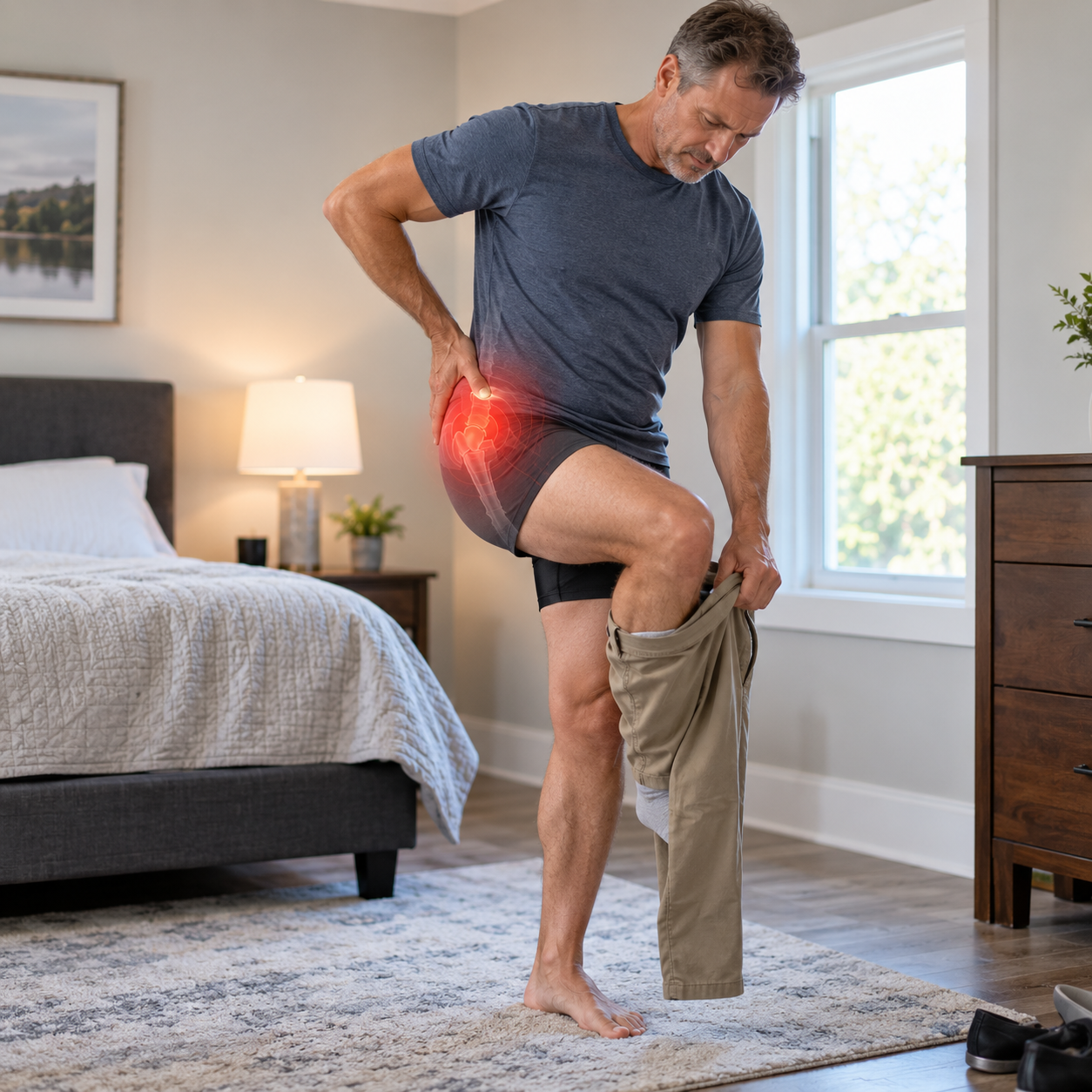
You step into your pants.
Put on a shoe.
Climb into the shower.
Step over something on the floor.
For just a few seconds, nearly your entire body weight is supported by one leg.
And suddenly your hip hurts.
Maybe it's a deep ache.
Maybe you feel pain along the outside of the hip.
Or perhaps the hip feels weak or unstable, and you immediately reach for something to hold onto.
Why can standing on one leg reveal hip problems that aren't nearly as noticeable when you're standing on both feet?
When both feet are on the ground, your body weight is shared between your legs.
Lift one foot, and everything changes.
The hip you're standing on now has to support your body while the muscles around it work to keep your pelvis level and your body balanced.
One of the most important muscle groups involved is the hip abductors, including the gluteus medius.
These muscles work hard every time you:
🚶 Take a step
👖 Put on pants
👟 Put on shoes
🪜 Climb stairs
🚿 Step into the shower
If the hip joint or surrounding muscles and tendons are irritated, these everyday movements can become surprisingly difficult.
Pain along the outer side of the hip doesn't always come from arthritis inside the joint.
Tendons around the outside of the hip can become irritated.
This is often grouped under the term greater trochanteric pain syndrome, or GTPS.
You might notice:
👉 Tenderness when pressing the outside of the hip
👉 Pain lying on that side in bed
👉 Pain climbing stairs
👉 Discomfort after longer walks
👉 Pain when standing primarily on that leg
Some people call all outer hip pain “bursitis,” but irritated tendons are frequently involved as well.
Yes.
Hip arthritis can make weight-bearing activities increasingly uncomfortable.
You may notice pain in the:
🦵 Groin
➡️ Front of the hip
🍑 Buttock
🦿 Upper thigh
Sometimes discomfort even seems to travel toward the knee.
Arthritis can also reduce hip mobility, which may make balancing and performing everyday movements more difficult.
This is one of those little changes people often dismiss.
Maybe years ago you could stand in the middle of the bedroom and put your pants on without thinking about it.
Now you automatically:
🤚 Hold the dresser
🪑 Sit on the bed
🧱 Lean against the wall
👖 Put the painful leg into your pants first
There's nothing wrong with making an activity safer.
But if you've gradually changed how you perform everyday tasks because your hip hurts or feels weak, that's useful information.
Pain isn't always caused solely by damage inside a joint.
The muscles around the hip are extremely important for stability.
If those muscles become weak, painful or poorly conditioned, standing on one leg can become more difficult.
You may notice that your pelvis drops toward one side or your upper body leans to compensate.
Sometimes that weakness isn't obvious during normal standing because both legs are helping.
Standing on one leg exposes it.
Here's the interesting part:
Walking is essentially a repeated series of brief one-legged stands.
Every time you take a step, there's a moment when one leg is supporting most of your body.
That's why someone who experiences hip pain standing on one leg may also notice:
🚶 Pain during longer walks
🪜 Difficulty with stairs
😣 Limping
🛒 Leaning on a shopping cart
🦵 Reduced walking endurance
The problem may become more obvious as the distance increases.
No.
Pain while standing on one leg doesn't tell us by itself whether someone needs surgery.
Hip arthritis is only one possible explanation.
Tendon problems, bursitis, muscle weakness and even problems originating in the lower back can produce hip-area symptoms.
The location of the pain, range of motion, strength and activities that trigger symptoms all help determine what's going on.
Depending on the cause, there may be non-surgical treatment options worth exploring.
Consider having it evaluated if:
🚩 Your walking tolerance is declining
🚩 You're developing a noticeable limp
🚩 Hip pain repeatedly wakes you at night
🚩 Stairs are becoming increasingly difficult
🚩 You need support for activities you previously did independently
🚩 Pain is interfering with normal daily activities
Sudden severe hip pain after a fall, particularly if you're unable to bear weight, should be evaluated promptly.
Standing on one leg might seem like a simple balance test.
But your hip is doing a tremendous amount of work.
If putting on pants, stepping into the shower or balancing on one leg consistently causes hip pain, pay attention to the pattern.
The problem could involve arthritis, irritated tendons, muscle weakness or another hip condition.
At Arthritis & Joint Pain Center, we help appropriate patients with chronic hip pain understand what's contributing to their symptoms and explore non-surgical treatment options, with the goal of reducing pain and improving mobility.
Because something as simple as putting on your pants shouldn't require a strategy.