You're walking through the kitchen and turn quickly.
You step out of the car and rotate to close the door.
Maybe you're playing golf, working in the yard or simply changing direction while walking.
Then suddenly…
OUCH. A sharp pain catches you in the hip.
Walking straight ahead might not bother you nearly as much.
But turning, twisting or pivoting can produce a completely different sensation.
Why?
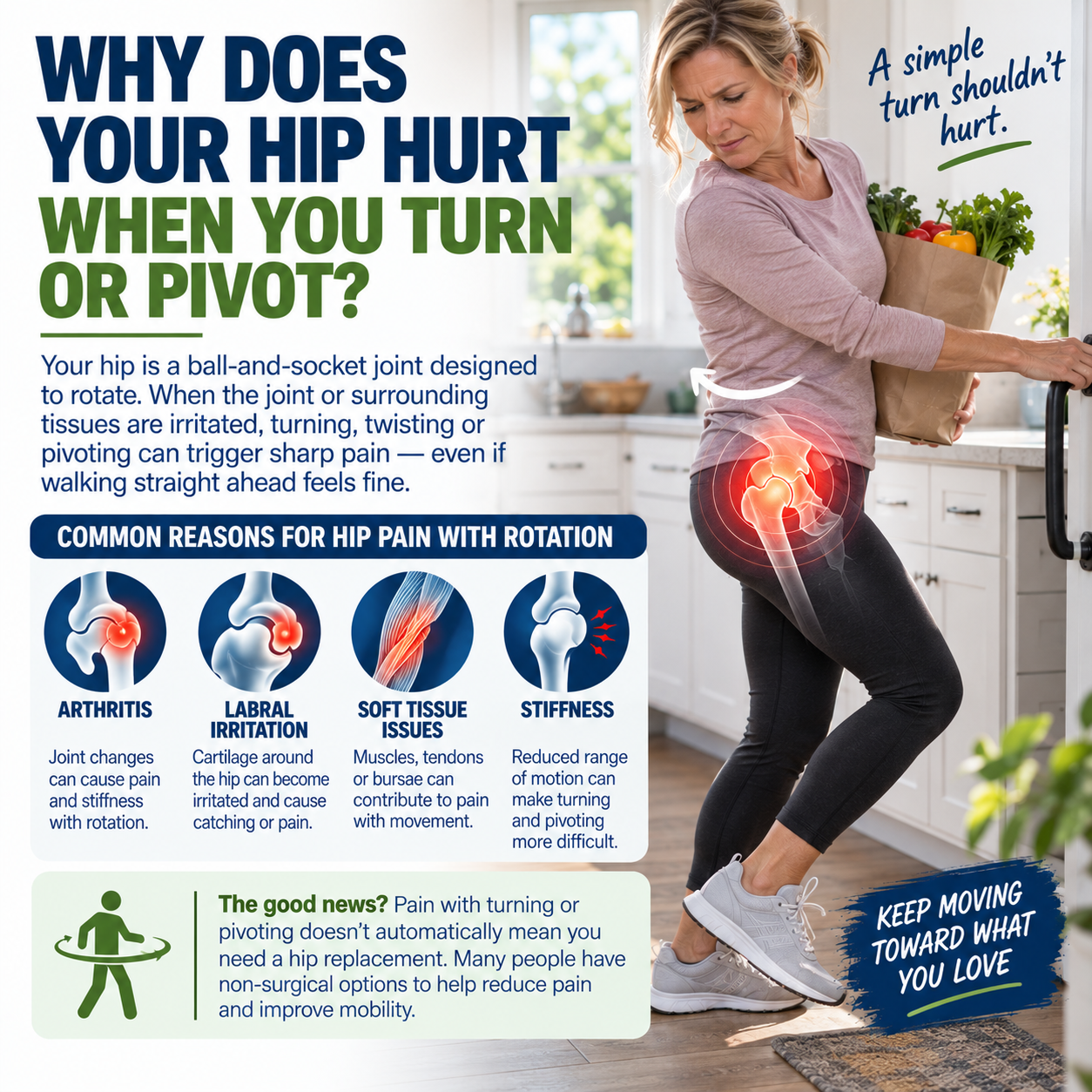
The hip is a ball-and-socket joint, which allows your leg to move in several directions.
That mobility is what lets you:
🚶 Walk
🪜 Climb stairs
👟 Put on shoes
🚗 Get in and out of a car
⛳ Swing a golf club
🔄 Turn and change direction
But when you pivot, your hip doesn't simply bend.
It rotates while supporting your body weight.
If the joint or surrounding tissues are irritated, that combination can expose a problem you barely notice when walking straight ahead.
Arthritis is one possible reason turning becomes uncomfortable.
As the hip becomes arthritic, people may develop increasing stiffness and reduced range of motion.
You might notice that it's becoming harder to:
👉 Turn your leg inward or outward
👉 Cross your legs
👉 Put on socks and shoes
👉 Get out of a low car
👉 Pivot while standing
👉 Change direction quickly
Sometimes people don't initially describe this as “hip pain.”
They simply say:
“If I turn the wrong way, it catches.”
Hip-joint problems often cause discomfort in the groin or front of the hip.
But hip pain isn't always felt exactly where you'd expect.
It may also be felt in the:
🦵 Upper thigh
🍑 Buttock
➡️ Outside of the hip
🦿 Knee
That's one reason hip problems are sometimes mistaken for back or knee problems.
Some people don't experience a constant ache.
Instead, they'll take a step, pivot and suddenly feel:
⚡ A sharp catch
🔒 Brief locking
🦴 Clicking or popping
😣 A deep pinch in the groin
Then they reposition the leg and it seems to release.
Several problems can contribute to catching or clicking, including arthritis and problems involving cartilage or soft tissues around the hip.
The sensation alone isn't enough to determine the cause.
Imagine turning while one foot remains planted.
Your body changes direction while the hip has to control that rotational force.
That's different from simply taking another step forward.
A hip that's comfortable during a short, straight walk may therefore hurt when you're:
⛳ Swinging a golf club
🧹 Turning while doing housework
🌱 Working in the garden
🛒 Changing direction in a store
🚗 Rotating as you get out of a vehicle
Even everyday movements can reveal reduced hip rotation.
One of the interesting things about chronic hip pain is how gradually people adapt.
Instead of rotating through the hip, you may begin turning your entire body.
You might take several little steps instead of pivoting.
You may swing both legs out of the car together.
Or you may avoid certain movements because you've learned:
“If I turn that way, it's going to hurt.”
Those compensations can become so automatic that you barely notice them.
No.
Pain with rotation doesn't automatically tell us how severe a hip problem is or what treatment someone needs.
Even if arthritis is present, treatment decisions shouldn't be based on one symptom or an X-rayv alone.
Your pain, mobility, strength, function, activity level and overall health all matter.
Depending on the cause and severity, there may be non-surgical treatment options worth considering.
Consider getting it checked if you're experiencing:
🚩 Persistent or worsening groin or hip pain
🚩 Increasing difficulty putting on shoes and socks
🚩 Loss of hip motion
🚩 Repeated catching or locking
🚩 Limping
🚩 Difficulty getting in and out of the car
🚩 Pain that's limiting walking or everyday activities
Sudden severe hip pain after a fall or injury, especially if you can't comfortably put weight on the leg, should be evaluated promptly.
If walking straight ahead feels relatively comfortable but turning or pivoting produces a sharp catch in your hip, pay attention to it.
Rotation places different demands on the hip than ordinary walking.
Arthritis, stiffness and other hip conditions can make those movements increasingly uncomfortable.
At Arthritis & Joint Pain Center, we help appropriate patients with chronic hip pain understand what's contributing to their symptoms and explore non-surgical treatment options, with the goal of reducing pain and improving mobility.
Because you shouldn't have to think about your hip every time you change direction.