ou walk into the grocery store feeling pretty good.
You grab a cart.
Start walking through the aisles.
And 10 or 15 minutes later...
Your hip starts aching.
Maybe you feel it in your groin.
Maybe it's along the outside of your hip.
Maybe the discomfort travels into your thigh.
And suddenly you're thinking less about what's on your shopping list and more about:
“How much longer until I can sit down?”
For people with chronic hip problems, prolonged walking can be one of the first everyday activities that becomes difficult.
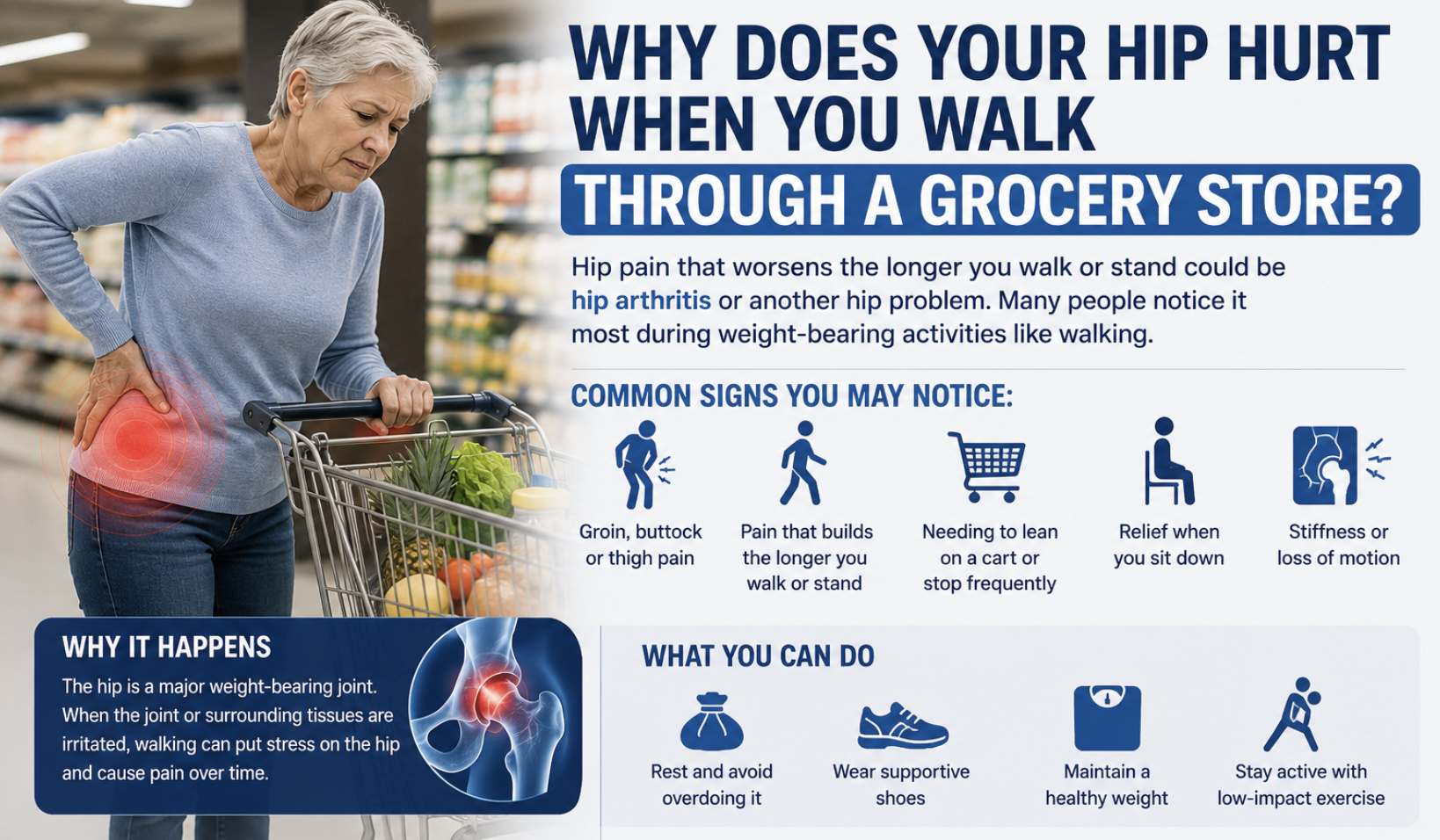
Your hip is a major weight-bearing joint.
Every time you take a step, the hip helps:
👉 Support your body weight
👉 Stabilize your pelvis
👉 Move your leg forward
👉 Absorb forces created during walking
When the joint or surrounding tissues are irritated, you might tolerate a few minutes of walking relatively well.
But as the distance increases, the discomfort can gradually build.
Hip osteoarthritis commonly produces pain with weight-bearing activities such as walking and standing.
People often assume hip pain should occur directly on the outside of the hip.
But that's not always where pain from the hip joint is felt.
Hip arthritis frequently causes pain in the groin, but discomfort can also occur in the:
That's one reason someone may initially think they have a thigh or knee problem when the hip is actually contributing.
This is an interesting clue.
Maybe you used to push your cart normally.
Now you find yourself:
🛒 Leaning forward onto the handle
🦵 Taking shorter steps
🚶 Walking more slowly
🛑 Stopping frequently
🪑 Looking for somewhere to sit
Your body is remarkably good at finding ways to make uncomfortable movements easier.
And sometimes those adaptations happen so gradually that you don't even realize you're doing them.
Hip arthritis doesn't necessarily hurt equally every minute of the day.
Symptoms can fluctuate depending on activity.
Earlier in the condition, pain may be intermittent and associated primarily with certain activities or prolonged activity.
As arthritis progresses, walking shorter distances may begin producing symptoms.
That's why someone might say:
“I can walk but just can't walk very far anymore.”
That distinction matters.
No.
Pain during walking can have several potential causes.
Problems involving the muscles, tendons or bursae around the hip can cause pain.
And sometimes what feels like hip pain actually originates in the lower back.
Sciatica, for example, can produce discomfort through the buttock, hip and leg.
That's why the location of the pain, what triggers it, and what makes it better all matter when determining the cause.
This is where people sometimes make a mistake.
They gradually stop:
Walking around the mall.
Going to festivals.
Taking longer walks.
Shopping without leaning on a cart.
And they tell themselves:
“I'm getting older. This is just what happens.”
Age can certainly increase the likelihood of arthritis.
But persistent pain and declining mobility shouldn't automatically be dismissed as normal aging.
No.
Hip pain while walking doesn't automatically mean you're headed for surgery.
Treatment depends on the cause and severity of the problem.
Some people with advanced hip arthritis ultimately benefit from replacement surgery, while others may be managed with conservative or non-surgical approaches.
Consider an evaluation if:
🚩 Your walking distance keeps getting shorter
🚩 You're developing a noticeable limp
🚩 You're frequently experiencing groin or thigh pain
🚩 Hip stiffness is getting worse
🚩 You're avoiding activities because of the pain
🚩 You're regularly relying on objects for support
Sudden severe hip pain, inability to bear weight, or significant pain following a fall or injury should receive prompt medical attention.
Sometimes the biggest sign of a hip problem isn't unbearable pain.
It's realizing:
“I don't walk as far as I used to.”
If grocery stores, vacations, shopping trips or walks with your family have gradually become harder because of your hip, it's worth figuring out why.
At our Arthritis & Joint Pain Center, we help appropriate patients with chronic hip pain explore non-surgical treatment options, with the goal of reducing pain and improving mobility.
The goal isn't simply to get through the grocery store. It's to keep doing the things that require you to stay on your feet.