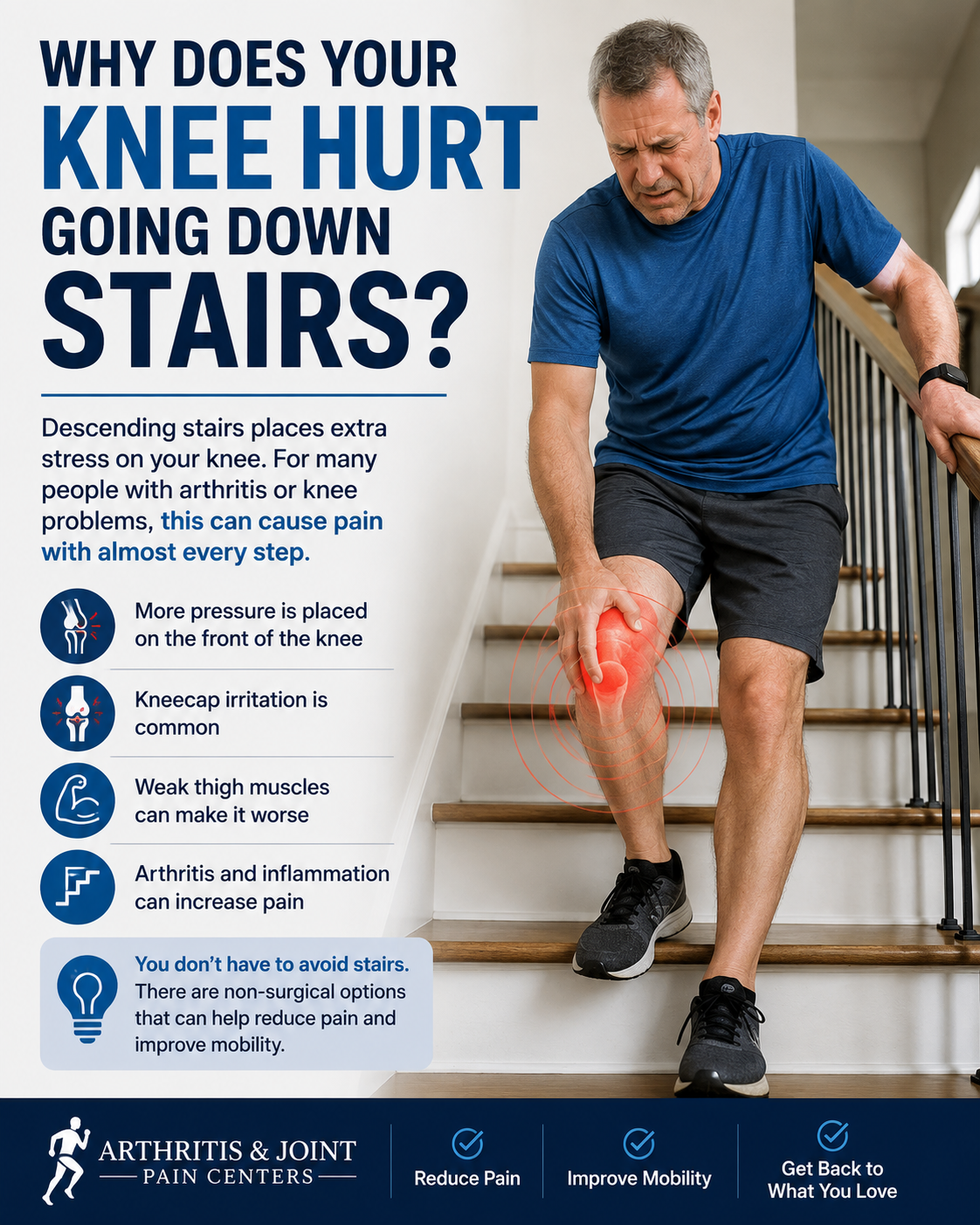
You make it up the stairs without too much trouble...
But then you turn around and start coming back down.
And suddenly:
👉 Your knee hurts with almost every step.
For many people with chronic knee pain, going downstairs is actually more uncomfortable than climbing up.
It may seem strange.
After all, shouldn't going UP require more work?
The answer has a lot to do with what your knee has to do as your body lowers from one step to the next.
When you walk downstairs, your knee doesn't simply support your body weight.
The muscles around the knee have to control your body as you gradually lower yourself onto the next step.
At the same time, the knee bends while significant force passes through the joint.
If structures around the knee are irritated, that combination can make descending stairs particularly uncomfortable.
Where do you feel the pain?
If it's primarily:
👉 In the front of the knee
👉 Behind the kneecap
👉 Around the edges of the kneecap
…the joint between the kneecap and thigh bone may be contributing.
Pain involving this area can become more noticeable during activities that load the knee while it's bent, including stairs and squatting.
Knee osteoarthritis commonly causes:
As the knee becomes more painful or loses mobility, stairs may gradually become one of the activities you notice most.
This is something we hear frequently.
Instead of walking normally downstairs, you start:
🪜 Turning slightly sideways
🤚 Holding tightly onto the railing
🦵 Leading with the same leg every time
👣 Taking one step at a time
You may not even remember when you started doing it.
You simply discovered:
“This hurts less.”
But those little changes can reveal just how much you've been compensating for your knee.
The quadriceps, the large muscles on the front of your thigh, play an important role in controlling your knee as you descend stairs.
If those muscles aren't providing enough support, stairs may feel more difficult.
That's one reason evaluating knee pain involves more than simply looking at an X-ray.
The strength, mobility, mechanics, and overall condition of the knee all matter.
No.
Pain going downstairs does not automatically mean your knee is severely damaged or that joint replacement is your next step.
There are many potential causes of knee pain, and treatment depends on what's actually producing the symptoms.
Some people ultimately require surgery.
Others may be candidates for conservative or non-surgical treatment approaches.
Consider an evaluation if:
🚩 Stair pain is becoming progressively worse
🚩 Your knee regularly swells
🚩 The knee feels unstable or gives way
🚩 You're losing range of motion
🚩 You've started avoiding stairs entirely
Sudden severe pain, inability to bear weight, significant swelling following an injury, or a hot and red knee should receive prompt medical attention.
If you can walk across a room relatively comfortably but dread every staircase...
👉 Pay attention to that pattern.
Going downstairs places unique demands on the knee, and pain during this movement may provide useful clues about what's happening inside and around the joint.
At our Arthritis & Joint Pain Centers, we help appropriate patients with chronic knee pain explore non-surgical treatment options, with the goal of reducing pain and improving mobility.
You shouldn't have to look for an elevator every time you see a flight of stairs.