You walk through the grocery store without much trouble.
You finish shopping, load your bags into the cart and head toward the parking lot.
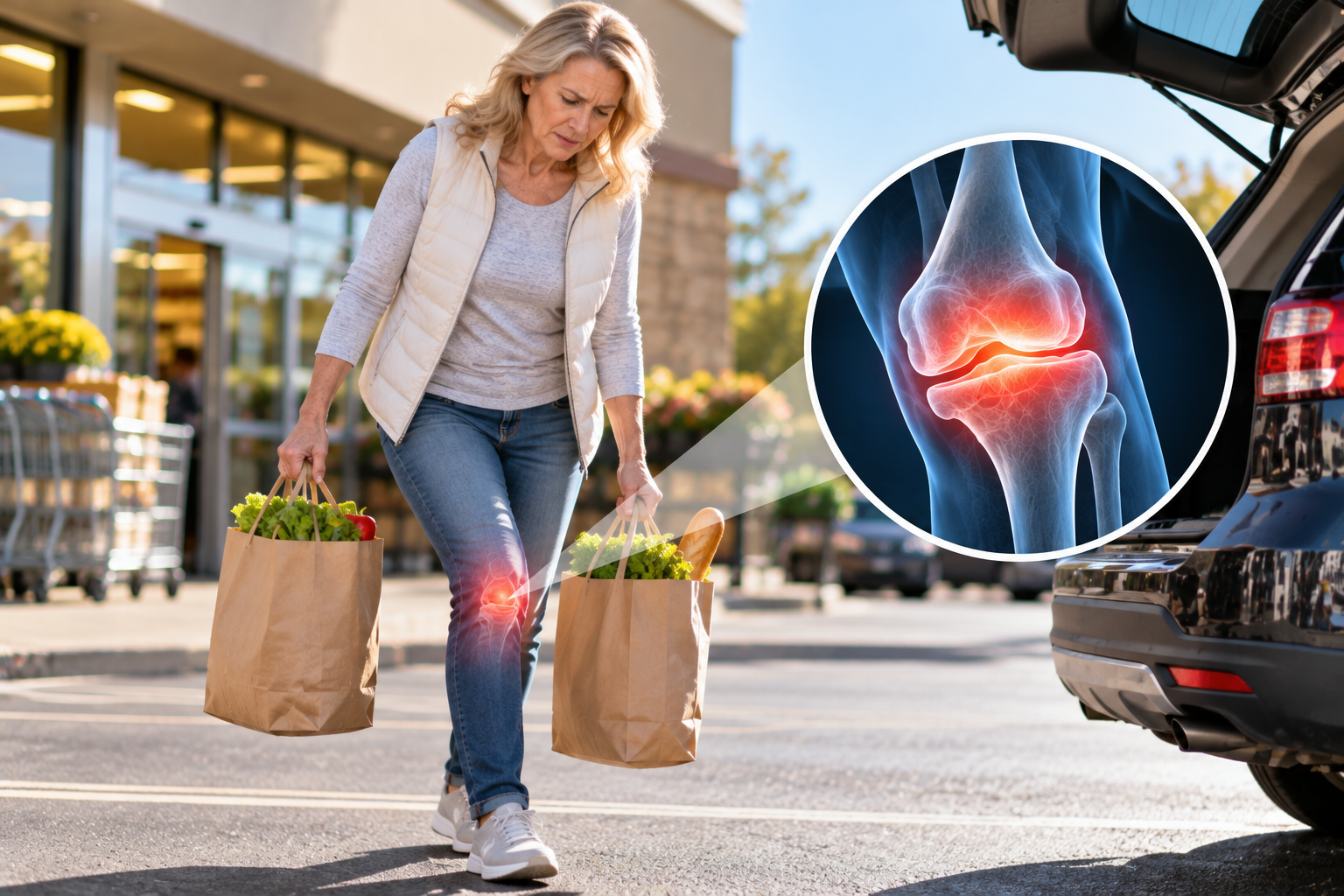
Then you pick up a couple of heavy grocery bags and start walking toward your car.
Suddenly, your knee starts hurting. 🦵😣
Maybe it's an aching sensation around the kneecap. Maybe you feel pressure inside the joint. Or perhaps your knee feels unstable when you're carrying something heavy.
You might even notice that walking without the bags feels perfectly fine.
So why does adding a little extra weight make such a difference?
Every time you walk, your knees help support your body while absorbing and transferring forces.
But the forces passing through your knee can be considerably greater than your actual body weight.
When you carry groceries, you're adding more weight for your legs to support.
And because walking involves repeatedly shifting your weight from one leg to the other, even a modest increase in the load you're carrying can make an already irritated knee more uncomfortable.
Think about carrying:
🛒 Two heavy grocery bags
💧 A case of bottled water
🐕 A large bag of dog food
🧺 A full laundry basket
🪵 An armful of firewood
If you have knee arthritis, these ordinary activities may become surprisingly difficult.
Knee arthritis involves changes within the joint, including the cartilage, bone and surrounding tissues.
As these changes develop, the knee may become more sensitive to certain activities.
Adding extra weight can increase the forces passing through the joint.
You may notice:
Interestingly, someone with knee arthritis may tolerate walking reasonably well but experience pain when carrying additional weight.
That doesn't necessarily mean the arthritis has suddenly become worse.
It may simply mean the activity has exceeded what the knee currently tolerates comfortably.
Here's something many people don't think about.
When you carry several grocery bags in one hand, your body has to adjust to the uneven weight.
You may lean slightly to one side or change the way you walk to maintain balance.
Your hips, knees and core muscles must work together to compensate.
For someone with a painful knee, that change in walking mechanics may increase discomfort.
You might even notice yourself carrying bags on the opposite side of your painful knee because it feels easier.
However, the relationship between carrying position and knee stress varies depending on how you walk, the weight you're carrying and your individual joint mechanics.
Your quadriceps are the large muscles on the front of your thigh.
They help straighten your knee and control its movement during walking, standing and stair climbing.
When these muscles are weak, your knee may have more difficulty handling demanding activities.
Carrying groceries adds another challenge.
Your leg muscles must control your body weight plus the additional load.
If your quadriceps aren't strong enough for the task, you may notice:
💪 Increased fatigue
🦵 Knee discomfort
🚶 Shorter steps
🪜 Difficulty climbing stairs
⚖️ A feeling of reduced stability
This is one reason appropriate strengthening exercises are often an important part of managing knee problems.
Walking across a flat parking lot is one thing.
Carrying groceries up the front steps is another.
When climbing stairs, your knee bends while your leg muscles help lift your body upward.
Add heavy grocery bags, and the task becomes more demanding.
You might notice yourself:
🪜 Taking one step at a time
🤚 Reaching for the railing
🦵 Leading with your stronger leg
🛍️ Carrying fewer bags per trip
😣 Feeling pain when pushing up onto the next step
These changes may seem minor at first.
But over time, they can become signs that your knee is affecting everyday function.
Sometimes the discomfort doesn't happen while you're carrying the groceries.
Instead, your knee begins aching after you've finished.
You sit down for a few minutes, then notice stiffness or pain when you stand back up.
This can happen when an already irritated joint responds to increased activity.
Some people also develop temporary swelling after more demanding physical tasks.
But recurring swelling shouldn't simply be dismissed as normal.
It may indicate that the joint needs further evaluation.
Not every knee that hurts when carrying groceries has arthritis.
Other possible contributors include:
Patellofemoral pain: Discomfort around or behind the kneecap, sometimes aggravated by loaded bending, stairs or squatting.
Meniscus problems: Certain meniscus injuries or degenerative changes can cause pain, particularly with twisting, squatting or other weight-bearing movements.
Tendon irritation: Tendons around the knee can become painful when repeatedly exposed to loads they aren't accustomed to.
Muscle weakness: Reduced strength or endurance can make demanding activities more difficult.
The location of the pain, accompanying symptoms and physical examination can help determine what's contributing.
If carrying groceries regularly aggravates your knee, consider a few adjustments.
1. Carry smaller loads.
Instead of bringing every grocery bag inside in one trip, divide them into lighter loads.
2. Use a cart when possible.
A rolling cart may reduce the amount of weight you need to carry.
3. Avoid rushing up stairs.
Take controlled steps and use a railing when available. Avoid carrying so much that you can't safely hold the railing or see your feet.
4. Distribute the weight comfortably.
Avoid overloading one side if it causes you to lean or change your walking pattern.
5. Work on appropriate leg strength.
Strengthening your quadriceps and hip muscles may help improve your ability to manage everyday activities.
The goal isn't to stop carrying things altogether.
It's to find ways to remain active without repeatedly aggravating your symptoms.
Absolutely not.
Pain during weight-bearing activities doesn't automatically mean you need knee replacement surgery.
Even when arthritis is present, treatment decisions should consider much more than one painful activity or an X-ray.
Factors such as pain severity, mobility, strength, swelling, previous treatments and overall function are important.
Depending on the cause, non-surgical treatment options may help reduce pain and improve mobility.
However, for patients with advanced arthritis and substantial ongoing disability despite appropriate conservative treatment, knee replacement may eventually be a reasonable option.
One of the biggest concerns with chronic knee pain is how gradually it can change your life.
At first, you stop carrying two bags at once.
Then you avoid carrying groceries upstairs.
Eventually, you ask someone else to unload the car because your knee simply doesn't tolerate it anymore.
It's not always the intensity of the pain that tells the whole story. Sometimes it's the everyday activities you've quietly stopped doing.
That gradual loss of independence is worth addressing.
Consider an evaluation if you're experiencing:
🚩 Increasing pain when carrying everyday items
🚩 Recurrent swelling after activity
🚩 Difficulty walking or climbing stairs
🚩 A feeling that your knee may give out
🚩 Reduced knee mobility
🚩 Persistent pain after ordinary activities
🚩 Increasing reliance on others for routine tasks
Seek prompt medical attention for a knee that becomes significantly swollen after an injury, an inability to bear weight, or a hot, red joint accompanied by fever.
If your knee feels fine walking through the grocery store but starts hurting when you carry your bags to the car, the added weight may be exposing a problem that ordinary walking doesn't challenge enough to reveal.
Arthritis, muscle weakness, kneecap irritation and other knee conditions can all contribute.
And difficulty carrying groceries doesn't automatically mean you need knee replacement surgery.
At Arthritis & Joint Pain Center, we help appropriate patients with chronic knee pain understand what's contributing to their symptoms and explore non-surgical treatment options, with the goal of reducing pain and improving mobility.
Because carrying your groceries shouldn't have to become something you dread.