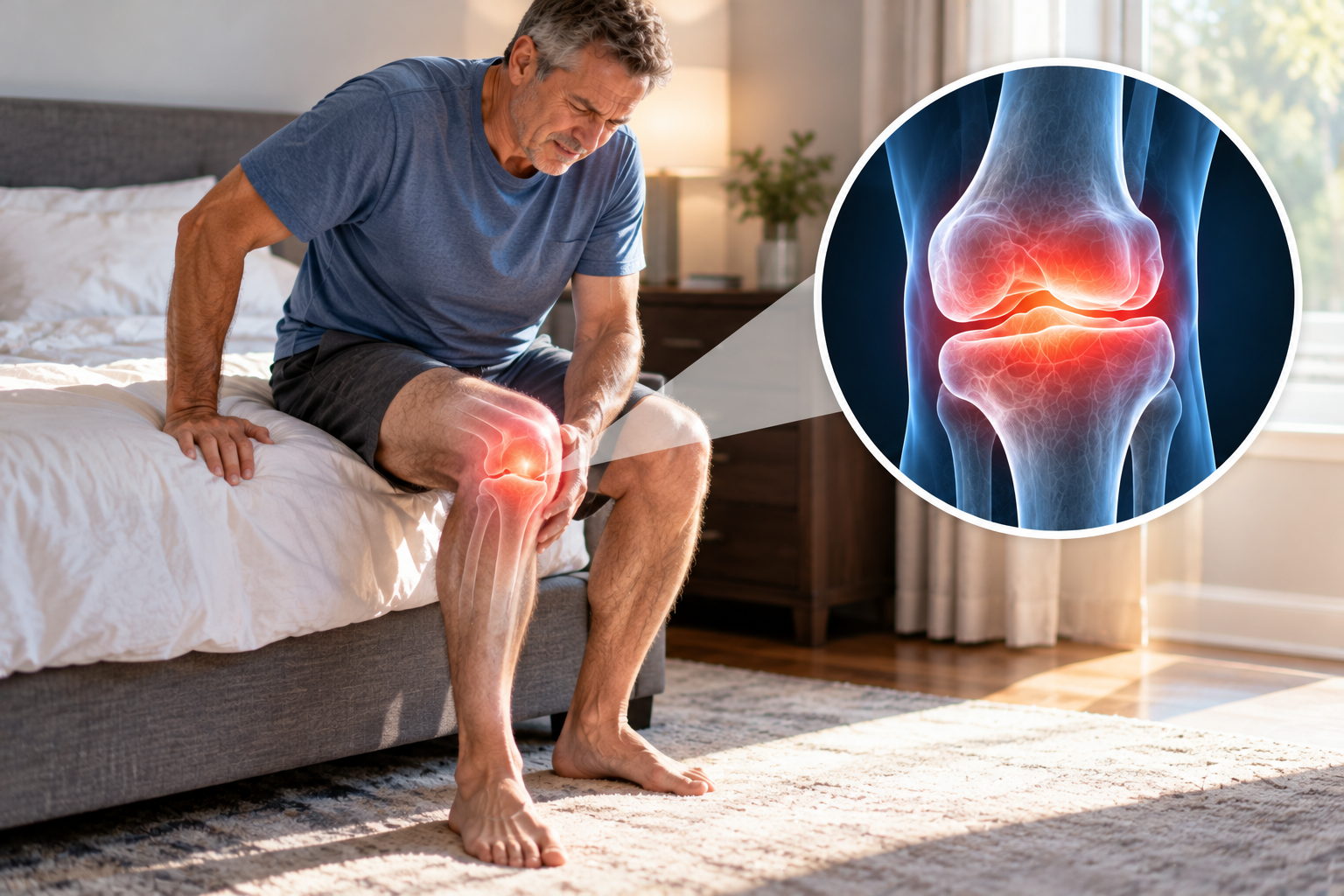
You lower yourself onto the floor to play with the grandkids.
Maybe you're gardening.
Cleaning under a cabinet.
Working around the house.
Or kneeling at church.
And the second your knee touches the ground…
OUCH. 🦵😣
Maybe it feels like a sharp pain directly on the kneecap.
Maybe there's pressure inside the knee.
Or perhaps getting back up is actually worse than kneeling down.
So why can something as simple as kneeling become so uncomfortable?
When you're walking, your body weight is distributed through your legs and feet.
Kneeling is different.
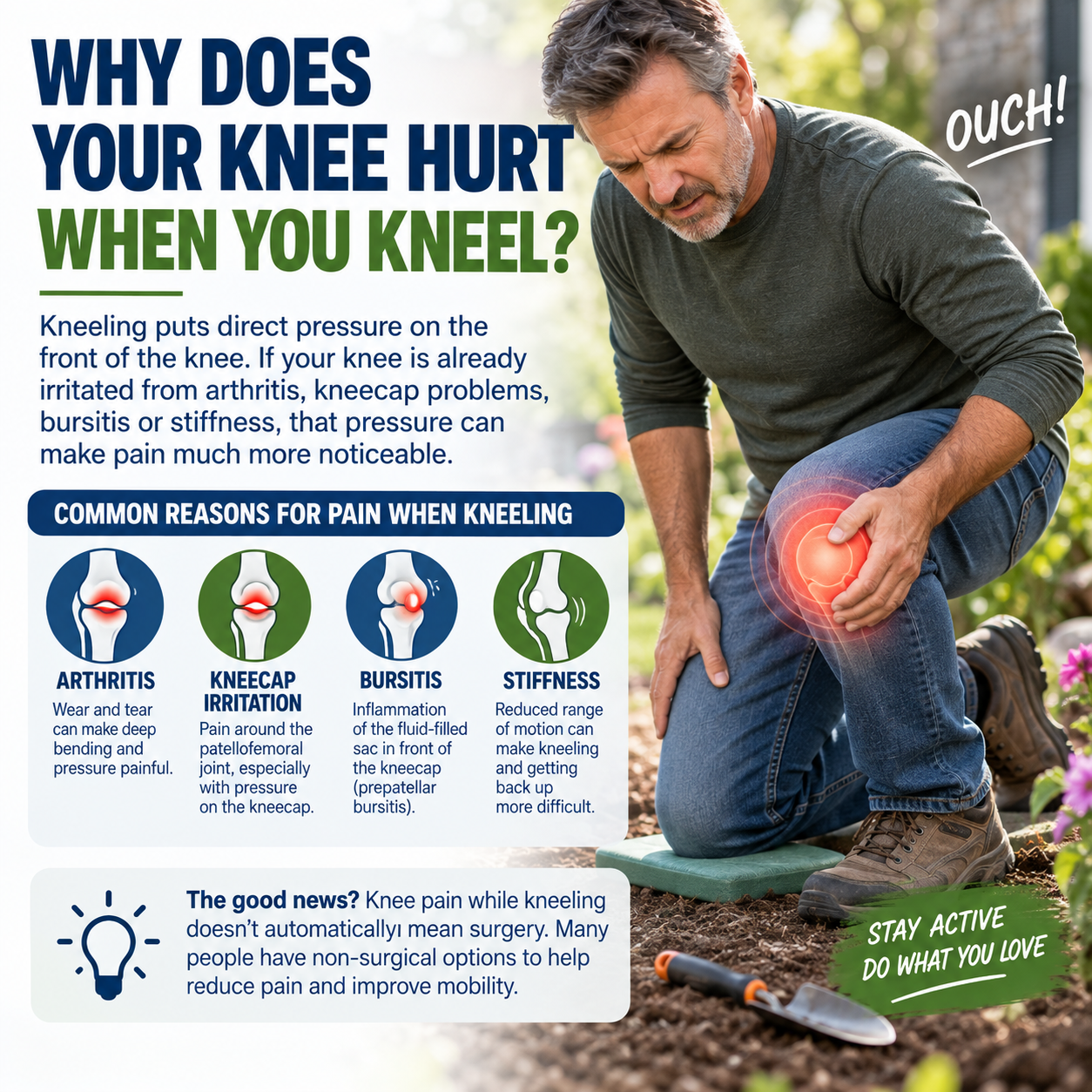
You're placing a significant amount of pressure directly onto the front of the knee—particularly around the kneecap, or patella.
If structures in or around the knee are already irritated, that pressure can make symptoms much more noticeable.
Knee arthritis is one possible reason kneeling becomes uncomfortable as we get older.
As arthritis progresses, you may develop:
👉 Joint stiffness
👉 Reduced range of motion
👉 Swelling
👉 Tenderness
👉 Grinding or crunching
👉 Pain with deeper bending
Kneeling usually requires the knee to bend significantly.
If your knee doesn't move as freely as it once did, that combination of deep bending plus pressure can be uncomfortable.
And sometimes the hardest part isn't getting down.
It's getting back up.
Where you feel the pain can provide useful clues.
Pain directly at the front of the knee may involve the patellofemoral joint, where the kneecap interacts with the thigh bone.
This area can also hurt during activities such as:
🪜 Going up or down stairs
🪑 Standing after sitting
🏋️ Squatting
🚗 Getting out of a low vehicle
🦵 Kneeling
That doesn't necessarily mean there's severe arthritis.
Several conditions can cause pain around the kneecap.
Yes.
Small fluid-filled sacs called bursae help reduce friction around joints.
One of these sits near the front of the kneecap.
Repeated kneeling can irritate this area and lead to prepatellar bursitis, sometimes called “housemaid's knee.”
You may notice:
🔴 Swelling directly over the kneecap
😣 Tenderness when touching the area
🦵 Pain when kneeling
🔥 Warmth around the front of the knee
People who spend significant time kneeling for work, hobbies or home projects can be particularly susceptible.
Standing from a kneeling position requires considerably more than simply straightening your knee.
Your quadriceps, hips and other muscles have to generate enough force to lift your body.
If your knee is painful or stiff, you may start compensating.
You might:
🤚 Push yourself up with your hands
🪑 Grab onto furniture
🦵 Put most of your weight through your “good” leg
🚫 Avoid getting onto the floor altogether
Over time, people can become so accustomed to these workarounds that they don't realize how much their knee has changed.
Absolutely not.
Pain while kneeling alone doesn't tell us how damaged a knee is—or whether someone needs surgery.
Even an X-ray showing significant arthritis doesn't determine treatment by itself.
Your symptoms, mobility, strength, activity level and overall function all matter.
For many people, there may be conservative or non-surgical options worth exploring before considering joint replacement.
Not necessarily.
If kneeling is uncomfortable, forcing yourself through significant pain isn't a great strategy.
But you may be able to modify the activity.
Try using:
✔️ A thick gardening pad
✔️ Knee cushions
✔️ A small gardening stool
✔️ Furniture for support when standing
✔️ Your stronger leg to help you rise
And pay attention to where the pain occurs.
Pain directly on the kneecap can mean something different from deep pain inside the joint or pain along the inner or outer knee.
Consider having your knee evaluated if pain is becoming persistent or you're noticing:
🚩 Recurrent swelling
🚩 Increasing stiffness
🚩 Difficulty walking or climbing stairs
🚩 Loss of motion
🚩 Your knee giving way
🚩 Pain interfering with everyday activities
A knee that becomes suddenly very swollen, hot and red—especially with fever or feeling ill—should be evaluated promptly.
If kneeling has gone from something you never thought about to something you actively avoid, your knee may be telling you something.
It could involve arthritis, irritation around the kneecap, bursitis or another knee problem.
The answer isn't automatically surgery.
At Arthritis & Joint Pain Center, we help appropriate patients with chronic knee pain understand what's contributing to their symptoms and explore non-surgical treatment options, with the goal of reducing pain and improving mobility.
Because being able to get down on the floor and confidently get back up again is a bigger part of staying active than many people realize.