You've been sitting for a while.
Maybe you're watching television.
Eating dinner at a restaurant.
Working at your desk.
Or riding in the car.
Then you stand up and—
OUCH.
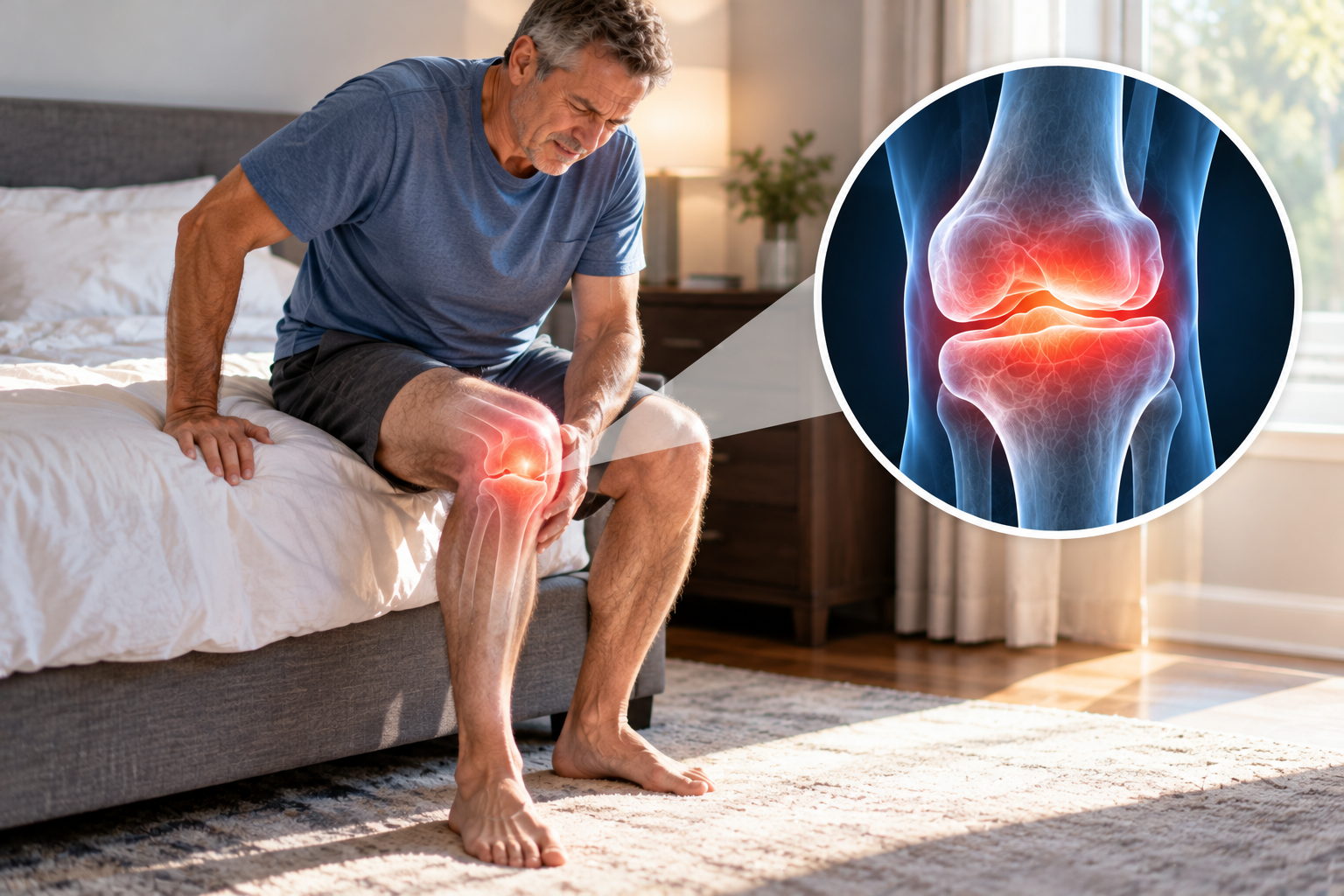
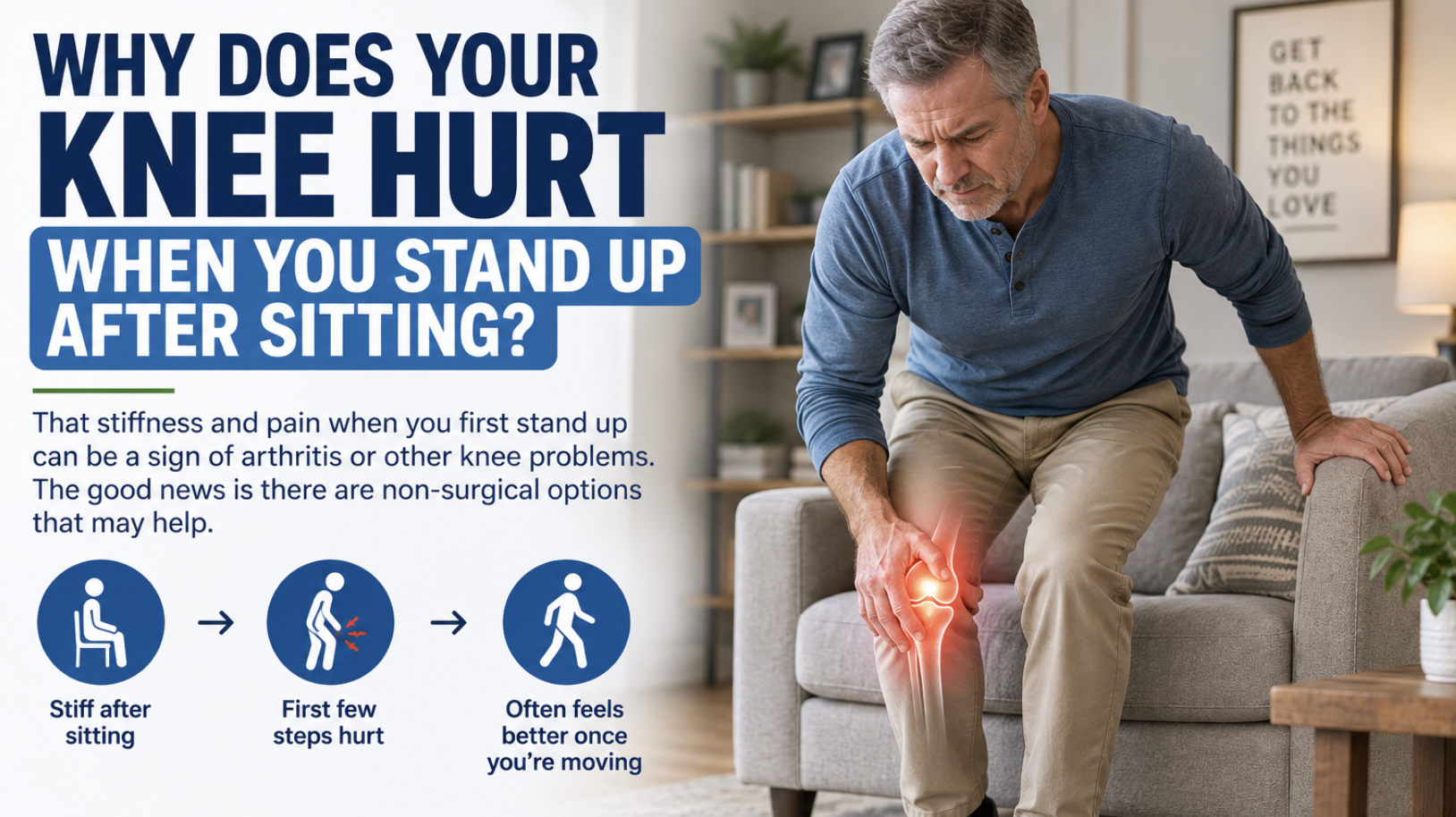
Your knee feels stiff.
The first few steps hurt.
You may even have to stand there for a moment before you start walking.
But here's the strange part...
After you walk around for a minute or two, the knee may actually start feeling better.
Sound familiar?
That pattern can occur with several knee problems, including osteoarthritis.
Your knee is designed to move.
When you sit for an extended period, the joint stays relatively still—often in a bent position.
For someone with an irritated or arthritic knee, that period of inactivity can make the joint feel stiff when movement begins again.
That's why the transition from:
Sitting → Standing → Walking
can sometimes be more uncomfortable than walking itself.
People with osteoarthritis commonly experience stiffness after periods of inactivity.
This is something we hear frequently:
“Once I get moving, I'm okay.”
You stand up.
Your first step hurts.
The second isn't great either.
Then after several steps...
Things start loosening up.
This phenomenon is sometimes referred to as start-up pain—discomfort that's most noticeable when movement begins after a period of rest.
Think about the position of your knee while you're eating dinner.
Your knee may remain bent for an hour or longer.
Then you have to:
🦵 Slide toward the edge of the booth
🪑 Push yourself upward
⚖️ Put your body weight onto the knee
🚶 Immediately begin walking
An irritated knee can make that entire sequence uncomfortable.
You may find yourself pushing harder with your arms or putting more weight through your “good” leg.
This can happen gradually.
You may start:
👉 Pushing off the armrests
👉 Putting both hands on your thighs
👉 Rocking forward before standing
👉 Choosing taller chairs
👉 Avoiding low couches
👉 Extending your painful leg before standing
Those little adaptations aren't necessarily bad.
But they can be clues that your knee isn't tolerating certain movements as well as it once did.
Pain after sitting doesn't automatically mean you have knee arthritis.
Other problems involving the kneecap, meniscus, tendons or surrounding tissues can also produce pain when transitioning from sitting to standing.
Where the pain occurs—and what other symptoms accompany it—can help determine what's happening.
Some people notice pain primarily in the front of the knee or behind the kneecap after sitting with the knee bent.
You might notice it:
🎬 At the movie theater
🚗 During a long drive
🍽️ At a restaurant
💻 Sitting at your desk
This type of pain can sometimes involve the patellofemoral joint—the area where the kneecap interacts with the thigh bone.
No.
Pain when standing after sitting doesn't tell you how severe arthritis is—or even prove that arthritis is the cause.
Symptoms and X-rays don't always line up perfectly.
Someone can have substantial arthritic changes and relatively manageable symptoms, while another person may experience significant pain with less dramatic imaging findings.
That's why the entire clinical picture matters.
Consider having persistent knee pain evaluated if:
🚩 Getting out of chairs is becoming increasingly difficult
🚩 Your knee repeatedly swells
🚩 You're losing range of motion
🚩 Your knee gives way or feels unstable
🚩 Your walking or daily activities are becoming limited
🚩 Symptoms continue to worsen
Sudden severe pain, significant swelling after an injury, inability to bear weight, or a hot, red knee—particularly with fever—deserves prompt medical attention.
Pay attention to what happens the next time you've been sitting for 30 or 60 minutes.
If you stand up and think:
“Give me a second, I have to get my knee moving.”
That pattern may be telling you something.
At Arthritis & Joint Pain Center, we help appropriate patients with chronic knee pain understand what's contributing to their symptoms and explore non-surgical treatment options, with the goal of reducing pain and improving mobility.
Standing up from a chair shouldn't feel like the hardest part of your day.