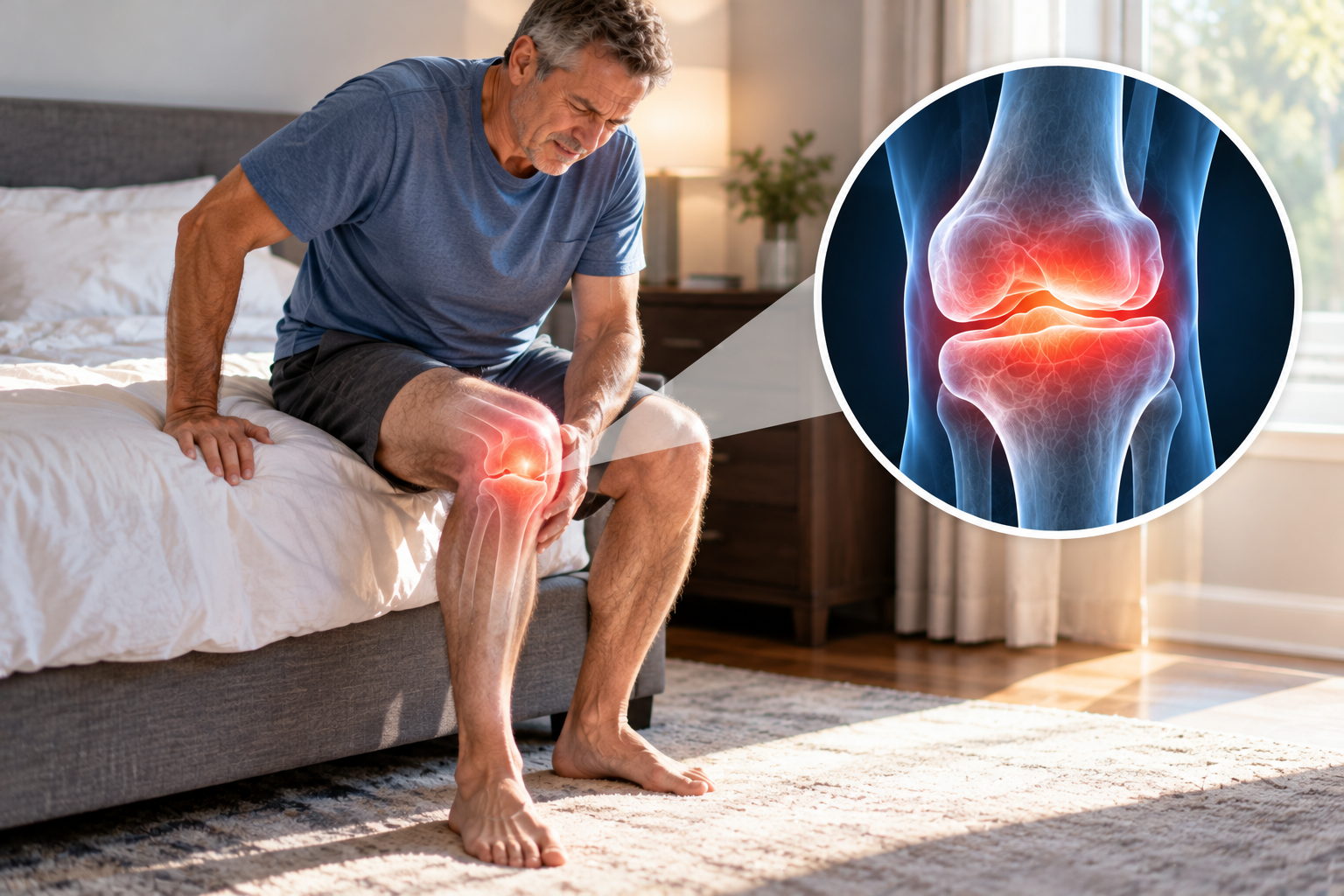
Walking on level ground feels pretty good.
Going up a hill might make your legs tired, but your knee manages.
Then you start walking downhill…
And suddenly your knee starts aching.
Maybe you shorten your steps.
Maybe you turn slightly sideways.
Or you find yourself carefully putting one foot in front of the other because every downhill step feels like you're putting the brakes on with your knees.
In a way, that's exactly what you're doing.
When you walk uphill, your muscles work to propel your body upward.
Walking downhill presents a different challenge.
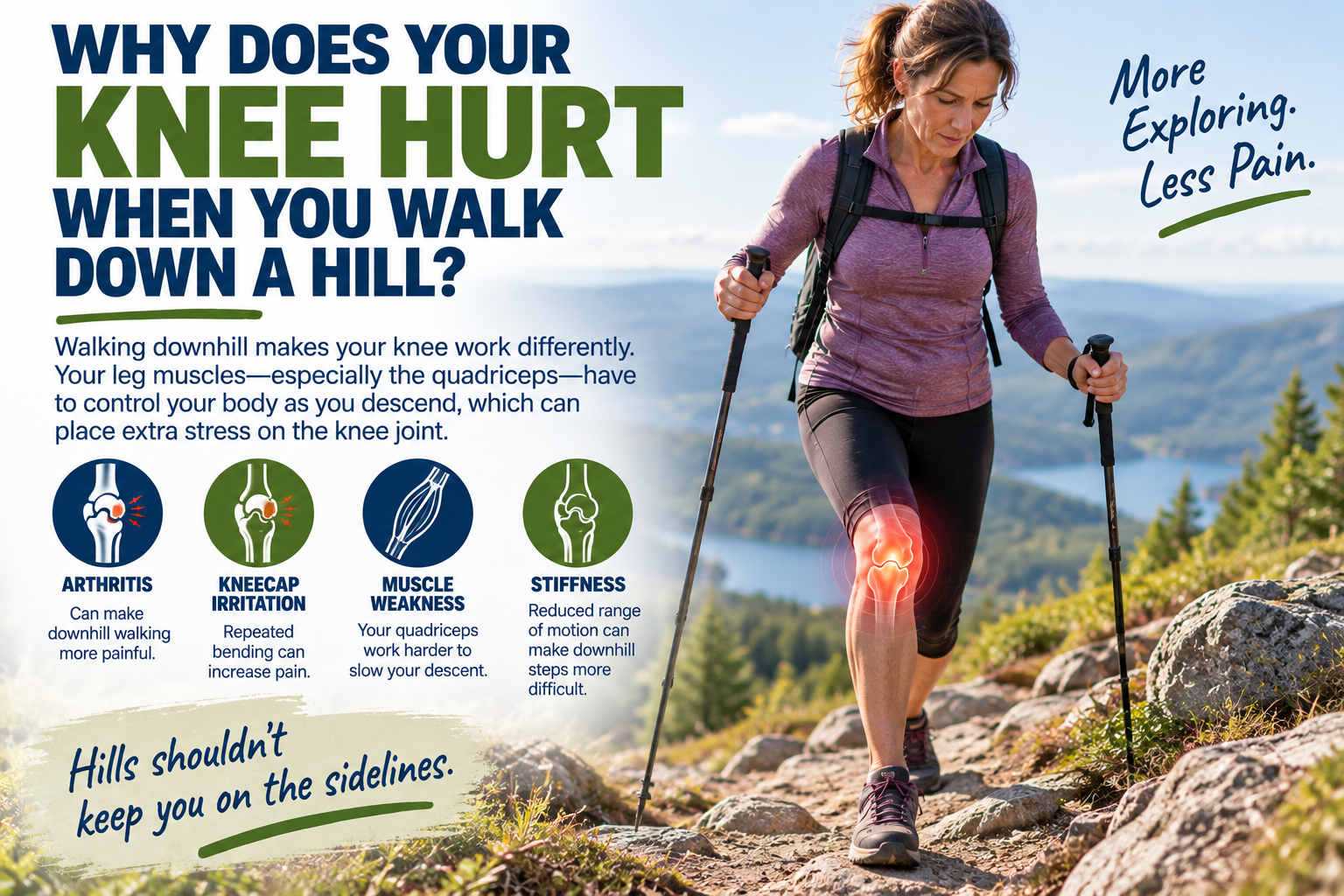
Your body is moving downward with gravity, and your muscles, particularly the quadriceps in the front of your thigh have to control that descent.
Instead of simply pushing you forward, they're helping prevent you from dropping too quickly with each step.
That controlled lowering can place considerable demand on the knee.
If your knee is already irritated, you may notice pain downhill long before you notice it on flat ground.
A common location for downhill knee pain is around or behind the knee cap.
Your kneecap or patella moves along the end of your thigh bone as your knee bends and straightens.
Walking downhill usually requires you to repeatedly bend the knee while controlling your body weight.
If the area around the kneecap is irritated, that repeated loading may become uncomfortable.
You may notice a similar problem when:
🪜 Walking downstairs
🪑 Lowering yourself into a chair
🏋️ Squatting
🥾 Hiking downhill
🚗 Stepping down from a taller vehicle
These activities have something in common: your knee has to control your body as you lower yourself.
Yes.
Knee arthritis can make downhill walking more difficult, particularly when arthritis is accompanied by stiffness, reduced motion or weakness.
You may experience:
🦵 Aching inside the knee
😣 Pain around the kneecap
🦴 Grinding or crunching
💧 Swelling after activity
🔒 Stiffness afterward
Some people can walk a surprisingly long distance on flat terrain but struggle considerably once the ground slopes downward.
Your knee doesn't work by itself.
The muscles around it help control the forces traveling through the joint.
Your quadriceps play an especially important role when walking downhill because they contract while lengthening to help slow and control your descent.
If those muscles aren't strong enough or pain causes you to stop using them normally the knee may have to compensate.
This can create a frustrating cycle:
Knee hurts → you use the leg less → muscles weaken → certain activities become even harder.
Pay attention to what you instinctively do when approaching a downhill section.
Do you:
👉 Take much shorter steps?
👉 Turn sideways?
👉 Walk unusually slowly?
👉 Reach for a railing?
👉 Put more weight through your other leg?
👉 Avoid hills altogether?
Those aren't random habits.
Your body may be trying to reduce the load on a painful knee.
This surprises a lot of people.
You might assume climbing uphill should hurt more because it feels harder.
But muscular effort and joint discomfort aren't necessarily the same thing.
Uphill walking may make you breathe harder and fatigue your muscles.
Downhill walking requires repeated braking and controlled knee bending.
For an irritated knee, that can sometimes be the more painful direction.
No.
Pain when walking downhill doesn't tell us by itself whether someone needs surgery.
The cause could involve arthritis, the kneecap, muscle weakness or another knee problem.
Even when arthritis is present, an X-ray is only part of the picture.
Your pain, strength, mobility, swelling, activity level and overall function matter too.
Depending on what's causing the problem, there may be non-surgical treatment options worth exploring.
If hills aggravate your knee, a few simple changes may help reduce the demand:
✔️ Take shorter, controlled steps
✔️ Avoid rushing downhill
✔️ Use a railing when available
✔️ Wear supportive footwear
✔️ Consider trekking poles when hiking
✔️ Work on appropriate leg strength and balance
The goal isn't necessarily to avoid hills forever.
It's to understand why your knee is struggling with them.
Consider an evaluation if:
🚩 Downhill walking is becoming increasingly difficult
🚩 Your knee repeatedly swells after activity
🚩 You're losing range of motion
🚩 The knee catches, locks or gives way
🚩 You're beginning to avoid activities you enjoy
🚩 Pain is affecting everyday walking
Sudden inability to bear weight, major swelling after an injury, or a hot, red knee—particularly with fever—should be evaluated promptly.
If your knee feels relatively good on flat ground but starts hurting the moment you head downhill, there's a mechanical reason that can happen.
Walking downhill requires your knee and quadriceps to repeatedly control your body as gravity pulls you downward.
Arthritis, kneecap irritation, stiffness or weakness can make that job much more uncomfortable.
At Arthritis & Joint Pain Center, we help appropriate patients with chronic knee pain understand what's contributing to their symptoms and explore non-surgical treatment options, with the goal of reducing pain and improving mobility.
Because the walk back down shouldn't be the part of the trip you dread.