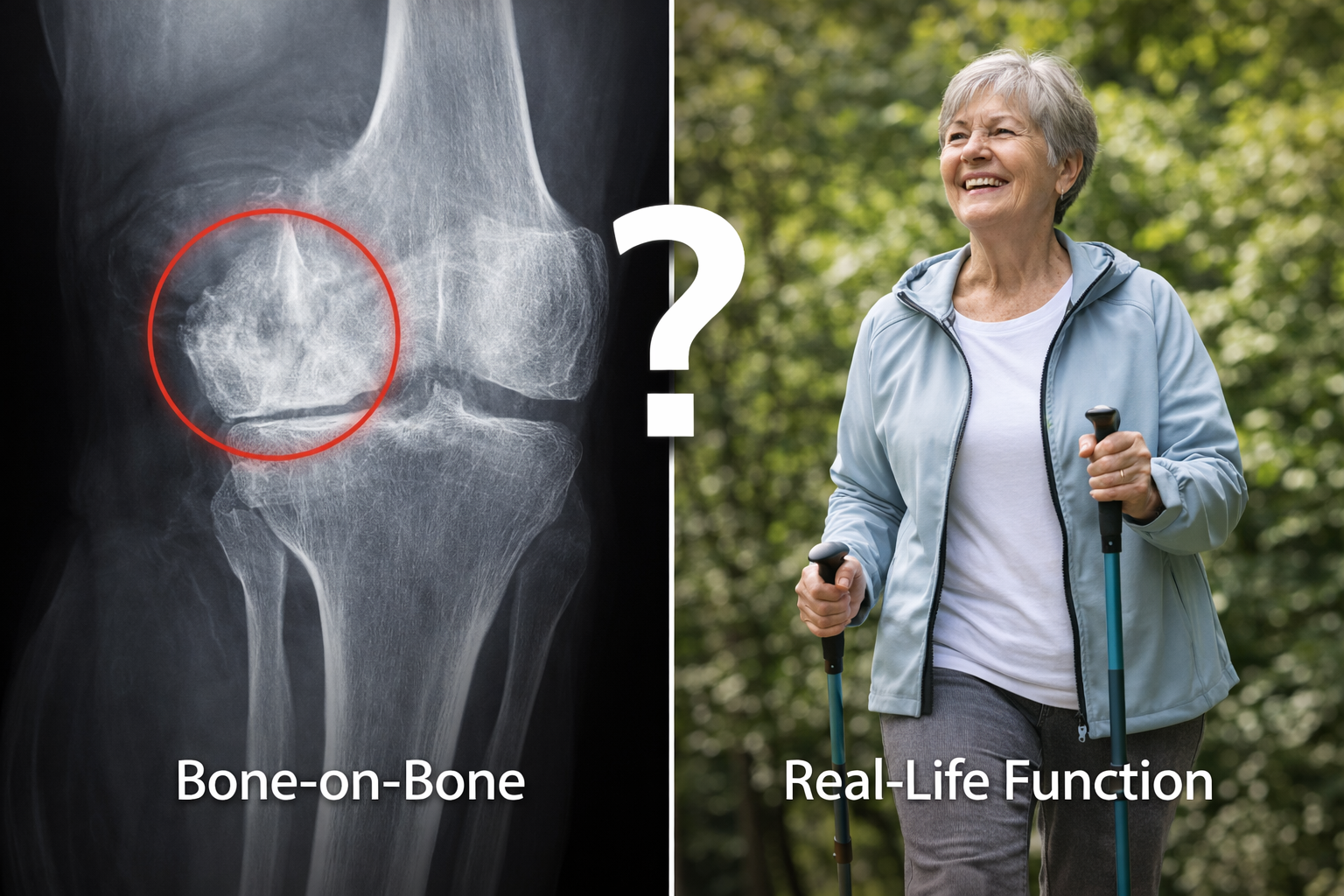
If you’ve ever had an X-ray or MRI for joint pain, you may have heard a phrase that stops people cold:
“You’re bone-on-bone.”
For many patients, those words feel like a verdict.
Like surgery is inevitable.
Like there’s nothing left to try.
But here’s the truth most people are never told:
👉 “Bone-on-bone” describes an image not your future.
When a doctor says “bone-on-bone,” they’re usually referring to:
What it does not automatically mean is:
Imaging shows structure not pain levels, inflammation, strength, or movement quality.
This may surprise you:
Many people with severe arthritis on X-ray:
And many people with mild findings:
Pain is influenced by far more than cartilage thickness.
Chronic joint pain is often driven by a combination of:
Cartilage loss is only one piece of the puzzle.
That’s why two people with the same X-ray can feel completely different.
For many patients, surgery enters the conversation when:
But that doesn’t mean every non-surgical option has failed.
It often means:
“We’ve reached the end of standard, symptom-based care.”
There’s a big difference.
Let’s be clear, surgery can be the right choice when:
But that decision should be made with confidence, not fear.
Even with advanced arthritis, many patients experience improvement when care focuses on:
The goal isn’t to “regrow cartilage overnight.”
It’s to help the joint function better with what’s there.
And for many people, that’s enough to:
Instead of asking:
“How bad does it look?”
A better question is:
“How well can this joint still function?”
Because function, not fear should guide decisions.
Being told you’re “bone-on-bone” does not automatically mean:
It means you deserve a conversation that looks beyond the image and focuses on how your joint is actually behaving in real life.
At Buffalo Arthritis & Joint Pain Center, we help patients understand what imaging findings really mean and whether non-surgical options still make sense before committing to surgery.
👉 An image shouldn’t make the decision for you.