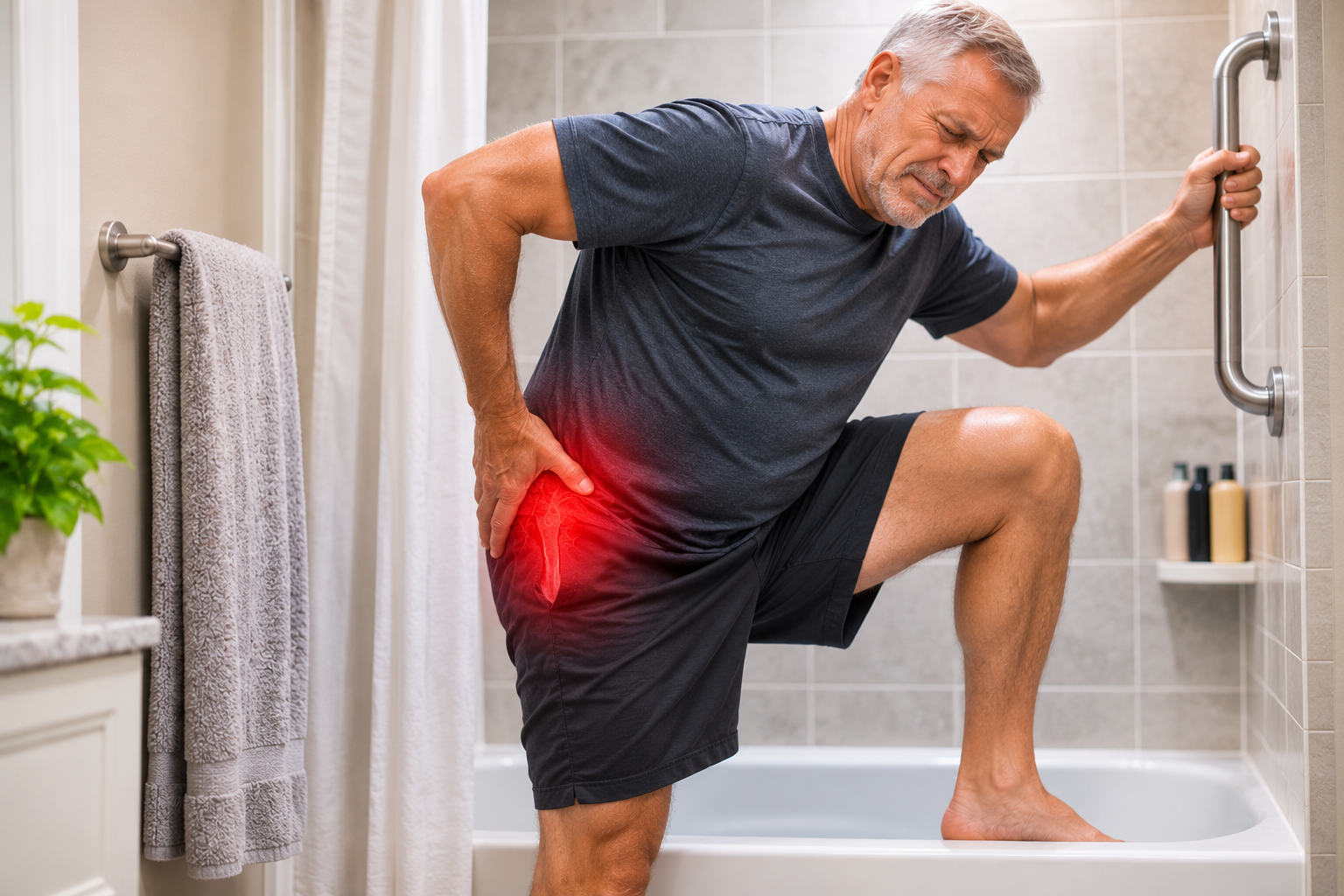
You’re getting ready for a shower or relaxing bath. You lift one leg over the side of the bathtub, and suddenly you feel a sharp pain in your hip.
Maybe the pain occurs in your groin as you raise your knee. Perhaps you feel an uncomfortable pulling sensation along the outside of your hip, or you struggle to balance while stepping over the tub.
You might even find yourself holding onto the wall or carefully changing how you enter the shower.
For many adults over 50, this everyday activity can become surprisingly difficult.
If your hip hurts when stepping into or out of the bathtub, the problem may involve hip osteoarthritis, limited joint mobility, tendon irritation, muscle weakness, or degenerative changes within the hip joint.
Understanding why this movement causes discomfort can help you recognize when an evaluation may be appropriate.
Your hip is a ball-and-socket joint that allows your leg to move forward, backward, sideways, and through rotational movements.
Stepping over the side of a bathtub requires several coordinated actions.
First, your hip flexors lift your thigh toward your torso. Next, your hip abductors move your leg outward to clear the bathtub wall.
Meanwhile, the opposite leg must support your body weight while your gluteal muscles stabilize your pelvis.
Finally, you must lower your foot safely onto the other side.
For someone with healthy hip mobility and good balance, these movements are generally manageable.
However, when arthritis, tendon irritation, or muscle weakness is present, the combination of hip flexion, abduction, rotation, and single-leg weight-bearing can become uncomfortable.
Here are seven possible explanations.
Hip osteoarthritis is one of the most common causes of chronic hip pain among adults over 50.
Osteoarthritis involves progressive changes affecting the articular cartilage, subchondral bone, and surrounding joint structures.
As the condition develops, patients may experience pain, stiffness, and reduced hip mobility.
Stepping into a bathtub can be particularly uncomfortable because it requires a combination of movements that may already be restricted.
Common symptoms of hip osteoarthritis include:
Some individuals can walk reasonably well on level ground but struggle with activities requiring greater hip movement.
This difference may reflect restrictions in hip flexion, abduction, and rotation.
Patients with advanced hip osteoarthritis are sometimes told they have bone-on-bone arthritis.
This term generally describes severe joint-space narrowing associated with substantial cartilage loss.
As degenerative changes progress, hip movement may become increasingly restricted or painful.
Lifting the leg over the bathtub can aggravate symptoms because the hip must move through a relatively large range of motion.
Patients may experience deep groin pain, stiffness, difficulty rotating the leg, or discomfort when transferring body weight.
Some individuals begin compensating by rotating their entire body rather than moving primarily through the hip.
However, a diagnosis of bone-on-bone hip arthritis does not automatically mean immediate hip replacement surgery is required.
Treatment decisions should consider symptom severity, functional limitations, overall health, and response to appropriate conservative management.
The hip flexor muscles help raise your thigh toward your torso.
One of the most important is the iliopsoas muscle group.
Every time you lift your leg to step into a bathtub, these muscles generate force to move your hip into flexion.
If the iliopsoas tendon or surrounding tissues are irritated, this movement may produce pain.
Hip flexor-related discomfort is commonly felt toward the front of the hip or groin.
Symptoms may become noticeable when lifting the knee, climbing stairs, entering a vehicle, or stepping over obstacles.
Some patients also experience discomfort after prolonged sitting.
However, persistent groin pain should not automatically be attributed to hip flexor tightness or irritation because osteoarthritis and other hip joint conditions can produce similar symptoms.
The gluteus medius and gluteus minimus muscles attach near the greater trochanter along the outside of the upper femur.
These muscles play an important role in stabilizing the pelvis during single-leg activities.
When stepping into a bathtub, one leg must support your body while the other moves over the tub wall.
This places additional demands on the gluteal muscles and tendons of the supporting leg.
When these tendons become irritated or develop degenerative changes, a condition known as gluteal tendinopathy may develop.
This is a common component of greater trochanteric pain syndrome.
Typical symptoms include pain along the outside of the hip, tenderness when lying on the affected side, discomfort climbing stairs, and pain during single-leg standing.
Unlike classic hip osteoarthritis, which often causes groin discomfort, gluteal tendinopathy typically produces pain over the lateral hip.
Sometimes the main problem is a gradual reduction in hip mobility.
Osteoarthritis, previous injuries, joint stiffness, and certain soft-tissue restrictions can limit the hip's available range of motion.
Stepping over the bathtub requires enough hip flexion and abduction to clear the tub wall.
If these movements become restricted, the person may compensate by leaning the trunk, rotating the pelvis, or lifting the foot in an awkward manner.
These compensations can make the movement more uncomfortable and potentially affect balance.
Some individuals notice they can walk without substantial difficulty but struggle when lifting their leg sideways.
Persistent restrictions in hip mobility deserve evaluation to determine whether the limitation originates within the joint or surrounding tissues.
Your hip abductors help stabilize your pelvis when standing on one leg.
These muscles are particularly important when stepping over obstacles, climbing stairs, or entering a bathtub.
When hip abductor strength is reduced, maintaining balance during single-leg standing may become more difficult.
Some individuals notice that their pelvis drops toward the unsupported side or that they lean their trunk over the supporting leg.
This can occur with hip muscle weakness, pain-related inhibition, or certain neurological conditions.
Older adults with chronic hip pain sometimes reduce their activity levels to avoid discomfort.
Unfortunately, reduced activity can contribute to additional muscle weakness.
Appropriate progressive strengthening can improve lower-extremity function and stability in many individuals.
However, the exercise program should be tailored to the patient's diagnosis, balance, and physical capabilities.
Not all hip pain originates within the hip joint.
Degenerative changes in the lumbar spine can contribute to referred pain involving the buttock, hip, or thigh.
Lumbar nerve root irritation may also produce pain, tingling, numbness, or weakness in the lower extremity.
When stepping into a bathtub, the combination of single-leg standing, trunk movement, and hip flexion may aggravate certain lumbar conditions.
Possible clues that the lower back is contributing include pain extending below the knee, numbness or tingling, lower-back discomfort, and symptoms that change with spinal position.
A clinical examination can help distinguish hip joint pathology from lumbar-related symptoms.
The location of discomfort may provide clues about the structures involved.
Pain location
Possible contributing conditions
Front of hip or groin
Hip osteoarthritis, iliopsoas tendinopathy
Outside of hip
Gluteal tendinopathy, greater trochanteric pain syndrome
Buttock or back of hip
Lumbar spine disorders, gluteal muscle problems
Deep within the hip
Osteoarthritis or another intra-articular condition
Hip pain extending toward the knee
Referred pain from the hip joint or lumbar spine
Pain accompanied by instability
Muscle weakness, balance impairment, or another contributing condition
Pain location alone cannot establish a diagnosis because several conditions can produce overlapping symptoms.
Walking on level ground generally requires less hip flexion and abduction than stepping over the side of a bathtub.
When entering a tub, you must lift your leg high enough to clear an obstacle while balancing on the opposite leg.
For individuals with hip osteoarthritis, the greater range of motion may aggravate joint pain.
For those with gluteal tendinopathy, the single-leg weight-bearing demands may reproduce lateral hip discomfort.
Muscle weakness or balance limitations can further increase the difficulty.
This helps explain why someone may walk comfortably around the house but struggle when entering a bathtub.
Several practical adjustments may help improve comfort and safety.
Securely mounted grab bars can provide additional support when stepping into or out of the bathtub.
Avoid relying on towel racks, shower curtains, or other fixtures that are not designed to support body weight.
A tub transfer bench allows you to sit before moving your legs over the bathtub wall.
This can reduce the need to balance on one leg while stepping over the tub.
For individuals with substantial hip pain, reduced mobility, or balance problems, a transfer bench may be particularly helpful.
If lifting your leg produces sharp pain, avoid repeatedly forcing the movement.
Instead, consider modifying your bathing setup or seeking assistance until the cause of your symptoms is evaluated.
Gentle range-of-motion exercises may help maintain hip flexibility.
However, the correct exercises depend on the underlying condition.
Avoid aggressive stretching that significantly increases pain.
Progressive strengthening of the hip abductors and extensors may improve stability and functional movement.
Exercises should be selected according to your physical capabilities and medical condition.
Use appropriate non-slip surfaces and keep the bathroom floor dry.
Avoid stepping into or out of the bathtub while rushing.
If you feel unsteady, do not attempt the transfer without suitable support.
Occasional discomfort during an awkward movement does not necessarily indicate a serious joint condition.
However, recurring hip pain when stepping into a bathtub deserves attention, particularly when it begins affecting your safety or independence.
Consider scheduling an evaluation if you experience persistent groin pain, increasing hip stiffness, difficulty lifting your leg, a progressive limp, or discomfort during other everyday activities.
Seek prompt medical care for severe hip pain after a fall, inability to bear weight, fever with a painful joint, or sudden neurological symptoms.
These findings may indicate conditions requiring urgent evaluation.
Not necessarily.
Many individuals with hip osteoarthritis and other chronic hip conditions can initially explore non-surgical management.
Depending on the diagnosis, conservative treatment may include therapeutic exercise, physical therapy, activity modification, weight management when appropriate, medications, and selected image-guided injections.
The effectiveness of individual treatments varies.
Non-surgical care cannot reliably regenerate cartilage lost through advanced osteoarthritis or guarantee that surgery will be avoided.
For patients experiencing severe, persistent pain and substantial functional limitations despite appropriate conservative management, hip replacement surgery may be a reasonable option.
An individualized evaluation can help determine which approach best matches the patient's condition and goals.
If hip pain makes it difficult to get into the bathtub, climb stairs, put on shoes, or enjoy everyday activities, it may be time to explore your options.
At Arthritis & Joint Pain Center, we help appropriate patients experiencing chronic hip pain and osteoarthritis understand their condition and explore individualized non-surgical treatment options.
Whether your discomfort has recently developed or you've been living with hip arthritis for years, an evaluation may help clarify your next steps.