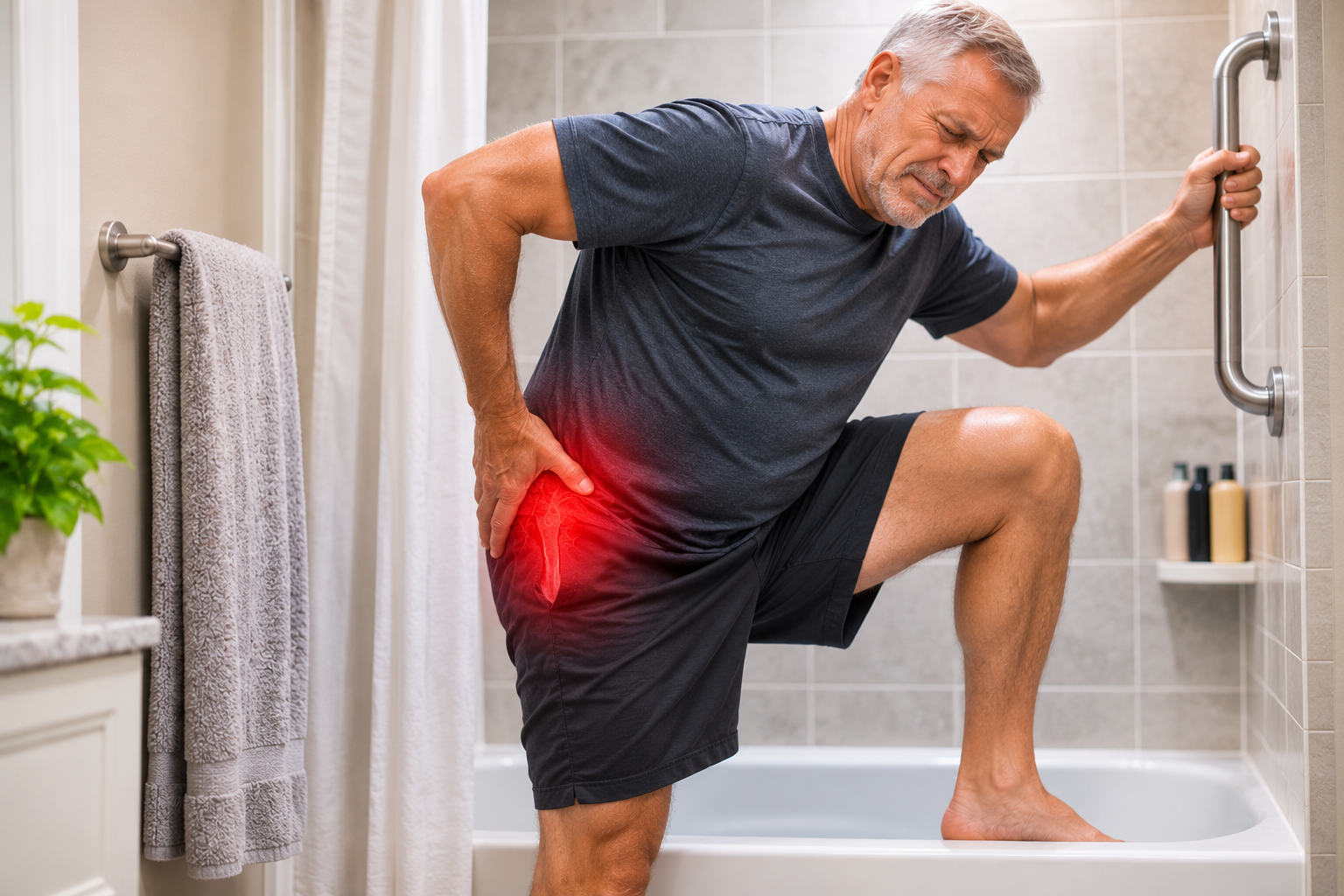
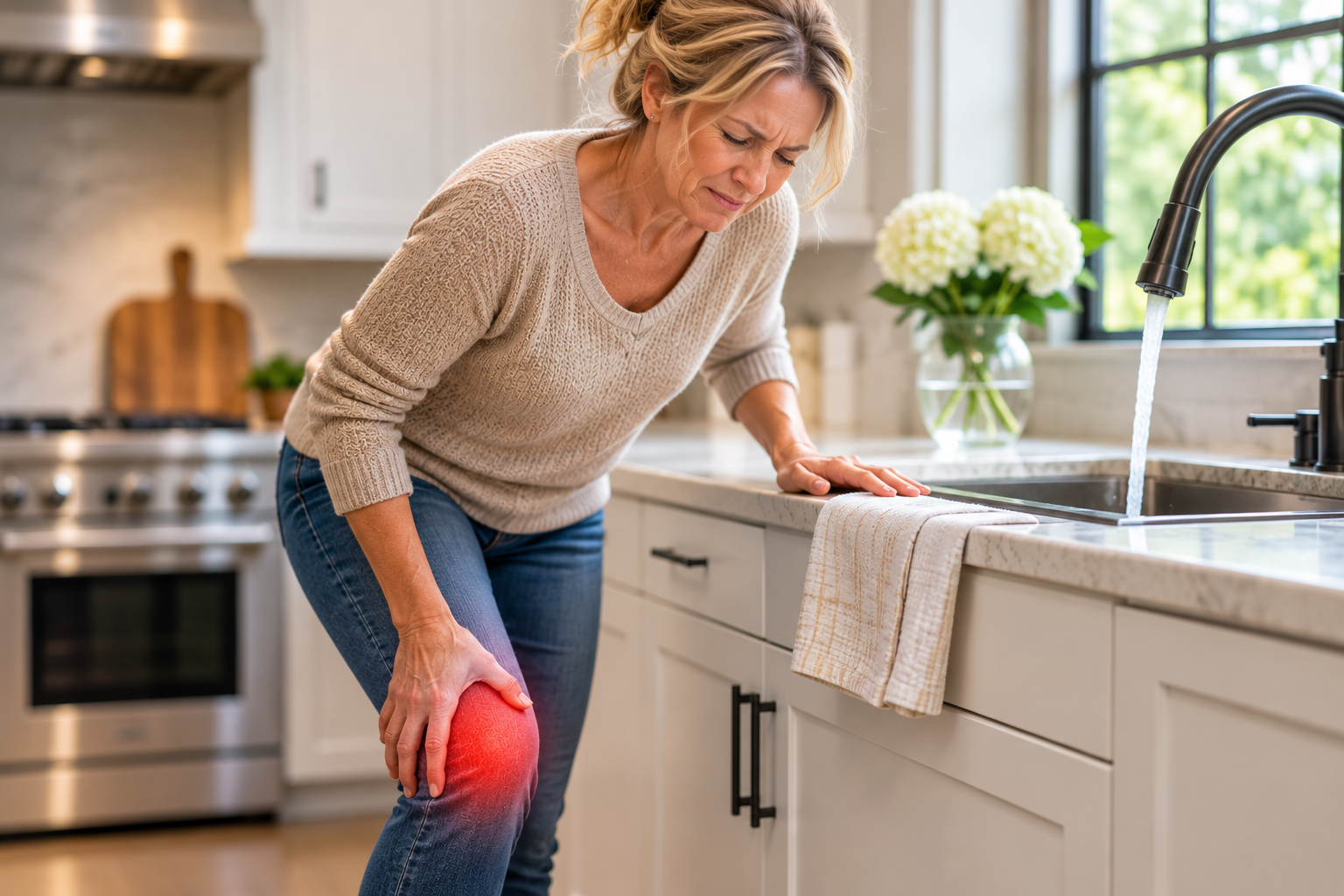
You're working in the garden, cleaning a low cabinet, picking something up off the floor, or playing with your grandchildren.
You lower yourself onto one knee, and suddenly you feel a sharp pain.
Maybe kneeling itself isn't too bad, but when you try to stand back up, your knee aches, feels weak, or simply doesn't want to cooperate.
Perhaps you've started avoiding activities that require getting down on the floor because you're concerned about whether you'll be able to get back up comfortably.
If your knee hurts when kneeling or getting up from the floor, the problem may involve osteoarthritis, kneecap arthritis, meniscus degeneration, bursitis, or weakness in the muscles that support your knee.
For adults over 50, difficulty kneeling can be an early sign of changes within the knee joint or surrounding tissues.
Understanding why this movement causes discomfort can help you recognize when an evaluation may be appropriate.
Your knee is a complex weight-bearing joint involving the femur, tibia, patella, cartilage, menisci, ligaments, and surrounding muscles.
Kneeling places different demands on these structures than ordinary walking.
When you lower yourself toward the floor, several things happen:
For someone with a healthy knee, these movements are generally manageable.
However, when arthritis, cartilage degeneration, inflammation, or muscle weakness is present, kneeling and standing back up may become increasingly uncomfortable.
Here are seven possible explanations.
Knee osteoarthritis is one of the most common causes of chronic knee pain among older adults.
Osteoarthritis involves degenerative changes affecting the articular cartilage, subchondral bone, synovium, and other structures within the knee.
As the condition progresses, patients may experience pain, stiffness, swelling, and reduced mobility.
Kneeling can be particularly uncomfortable because it requires substantial knee flexion.
Getting back up also places significant demands on the joint as it transitions from a deeply bent position to supporting body weight.
Common symptoms of knee osteoarthritis include:
Some individuals can walk reasonably well on level ground but experience substantial pain when attempting to kneel.
This difference reflects the greater range of motion and mechanical loading required during kneeling.
The patellofemoral joint is located between the kneecap, or patella, and the femur.
As your knee bends, the kneecap moves within a groove at the end of the femur.
This joint helps transmit force from the quadriceps muscles during knee movement.
However, the patellofemoral joint experiences substantial compressive forces during activities involving deep knee flexion.
Kneeling, squatting, and rising from the floor can all increase loading in this region.
When cartilage degeneration affects the underside of the kneecap or the corresponding femoral surface, these activities may become painful.
Common symptoms include pain behind or around the kneecap, grinding sensations, discomfort descending stairs, and difficulty rising from a low position.
Some patients describe a deep pressure sensation in the front of the knee.
Others experience sharp pain when attempting to push themselves upward.
Not all knee pain associated with kneeling originates inside the joint.
The prepatellar bursa is a small fluid-filled sac located in front of the kneecap.
Its purpose is to reduce friction between the skin and underlying tissues.
Repeated kneeling can irritate this bursa, producing a condition known as prepatellar bursitis.
This is sometimes called housemaid's knee because it has historically been associated with occupations involving frequent kneeling.
Symptoms may include:
Prepatellar bursitis differs from osteoarthritis because the swelling is typically concentrated in front of the kneecap rather than deep within the joint.
A red, hot, increasingly swollen bursa, particularly with fever, requires prompt evaluation because infection is possible.
The medial and lateral menisci are crescent-shaped fibrocartilaginous structures that help distribute load and stabilize the knee.
As people age, degenerative changes may develop within these structures.
Deep knee bending can increase mechanical stress on portions of the menisci.
For someone with symptomatic meniscus degeneration, kneeling or rising from a squat may produce discomfort.
Patients may experience pain along the inner or outer joint line, catching sensations, intermittent swelling, or discomfort when twisting.
However, degenerative meniscus tears are common on imaging among older adults and do not always cause symptoms.
Many patients with degenerative meniscus conditions can initially pursue non-surgical management, including appropriately selected strengthening exercises.
Persistent mechanical locking or inability to fully straighten the knee requires medical evaluation.
Some individuals with advanced knee osteoarthritis are told they have bone-on-bone arthritis.
This description generally refers to severe joint-space narrowing associated with substantial cartilage loss.
When advanced degenerative changes are present, the knee may have reduced tolerance for deep flexion and weight-bearing.
Kneeling can become especially difficult because it combines substantial joint bending with pressure against the floor.
Getting back up may be even more challenging.
Patients may experience deep aching, sharp discomfort, stiffness, reduced mobility, or difficulty generating enough force to stand.
However, the severity of degenerative changes visible on an X-ray does not always correspond directly with symptom severity.
A diagnosis of bone-on-bone knee arthritis does not automatically mean immediate knee replacement surgery is necessary.
Treatment decisions should consider pain severity, functional limitations, overall health, and response to appropriate conservative management.
Your quadriceps muscles are responsible for extending the knee and helping control movement during standing, walking, and squatting.
When you lower yourself toward the floor, the quadriceps work eccentrically to control knee flexion.
When you stand back up, they generate force to straighten the knee.
This makes rising from a kneeling position considerably more demanding than ordinary level walking.
For individuals with reduced quadriceps strength, getting up from the floor may become difficult.
Older adults with chronic knee pain sometimes reduce their physical activity to avoid discomfort.
Unfortunately, reduced activity can contribute to further muscle weakness.
This may create a cycle in which knee pain limits activity, muscle strength declines, and everyday movements become increasingly challenging.
Appropriate progressive strengthening can improve knee function and overall mobility.
Sometimes the main problem is a gradual reduction in knee range of motion.
Osteoarthritis, previous injuries, swelling, and soft-tissue restrictions can make deep knee bending uncomfortable.
For example, someone who has avoided kneeling for several years may gradually lose tolerance for that position.
When they attempt to kneel again, the movement may feel tight, stiff, or painful.
Some individuals experience discomfort behind the knee when bending deeply.
Others notice pressure around the kneecap or difficulty returning to a standing position.
Persistent loss of knee mobility should be evaluated to determine whether the primary limitation involves arthritis, swelling, soft tissues, or another joint condition.
The location of discomfort can provide useful clues about the underlying problem.
Pain location
Possible contributing conditions
Directly over the kneecap
Prepatellar bursitis, superficial tissue irritation
Behind the kneecap
Patellofemoral arthritis or patellofemoral pain
Inside of the knee
Medial compartment osteoarthritis, medial meniscus problems
Outside of the knee
Lateral compartment arthritis, lateral meniscus problems
Behind the knee
Joint swelling, Baker's cyst, posterior soft-tissue restrictions
Deep throughout the joint
Osteoarthritis or another intra-articular condition
Pain location alone cannot establish a diagnosis because several conditions produce overlapping symptoms.
Many people notice that lowering themselves onto the floor is uncomfortable, but standing back up is considerably more difficult.
This happens because rising from a kneeling position requires substantial muscular force.
Your quadriceps must extend the knee while your gluteal muscles help lift and stabilize your body.
At the same time, the knee must tolerate increasing weight-bearing as you transition toward standing.
For individuals with arthritis, this combination of deep flexion, muscular effort, and joint loading can aggravate symptoms.
Muscle weakness may further increase the difficulty.
Some individuals begin relying heavily on furniture or their arms to push themselves upward.
Others avoid getting down on the floor altogether.
These changes can be important indicators of declining lower-extremity function.
Several practical strategies may help make kneeling and getting up from the floor more manageable.
A thick kneeling pad may reduce direct pressure on the front of your knee.
This can be particularly helpful for individuals with sensitivity over the kneecap or a history of prepatellar bursitis.
However, cushioning does not eliminate the deeper joint-loading demands associated with kneeling.
Remaining in a deeply bent position for extended periods may aggravate arthritis or other knee conditions.
Consider changing positions regularly or using a small gardening stool.
A sturdy chair, bench, or other secure support may help you transition from kneeling to standing.
Avoid pulling on unstable furniture.
If balance or strength is limited, consider learning a safer floor-to-stand technique with a physical therapist.
Progressive strengthening can improve the ability to stand, squat, and perform everyday activities.
Exercises may include modified sit-to-stands, partial squats, and other movements selected according to your symptoms and physical capabilities.
Gentle range-of-motion exercises may help maintain flexibility.
However, avoid forcing your knee into painful deep flexion.
The appropriate movement program depends on the underlying diagnosis.
If kneeling consistently aggravates your knee, consider using long-handled gardening tools, a raised garden bed, or a stable stool for low-level tasks.
The goal is to remain active while reducing unnecessary discomfort.
Occasional discomfort from kneeling on a hard surface does not necessarily indicate a serious joint problem.
However, recurring pain deserves attention, particularly when it begins interfering with everyday activities.
Consider scheduling an evaluation if you experience:
Seek prompt medical attention for sudden severe swelling, a hot or red knee, fever with joint pain, inability to bear weight, or significant symptoms following an injury.
These findings may indicate conditions requiring urgent evaluation.
Not necessarily.
Many individuals with knee osteoarthritis, including some with advanced degenerative changes, can explore non-surgical management before considering joint replacement.
Depending on the diagnosis, treatment may include therapeutic exercise, physical therapy, activity modification, weight management when appropriate, medications, and selected injection-based treatments.
The effectiveness of individual treatments varies.
Non-surgical care cannot reliably regenerate cartilage lost through advanced osteoarthritis or guarantee that surgery will be avoided.
For patients experiencing severe pain and substantial functional limitations despite appropriate conservative management, knee replacement surgery may be a reasonable option.
An individualized evaluation can help determine the most appropriate next step.
If knee pain makes it difficult to kneel, get up from the floor, garden, play with your grandchildren, or enjoy everyday activities, it may be time to explore your options.
At Arthritis & Joint Pain Center, we help appropriate patients experiencing chronic knee pain and osteoarthritis understand their condition and explore individualized non-surgical treatment options.
Whether your symptoms have recently developed or you've been living with knee arthritis for years, an evaluation may help clarify your next steps.