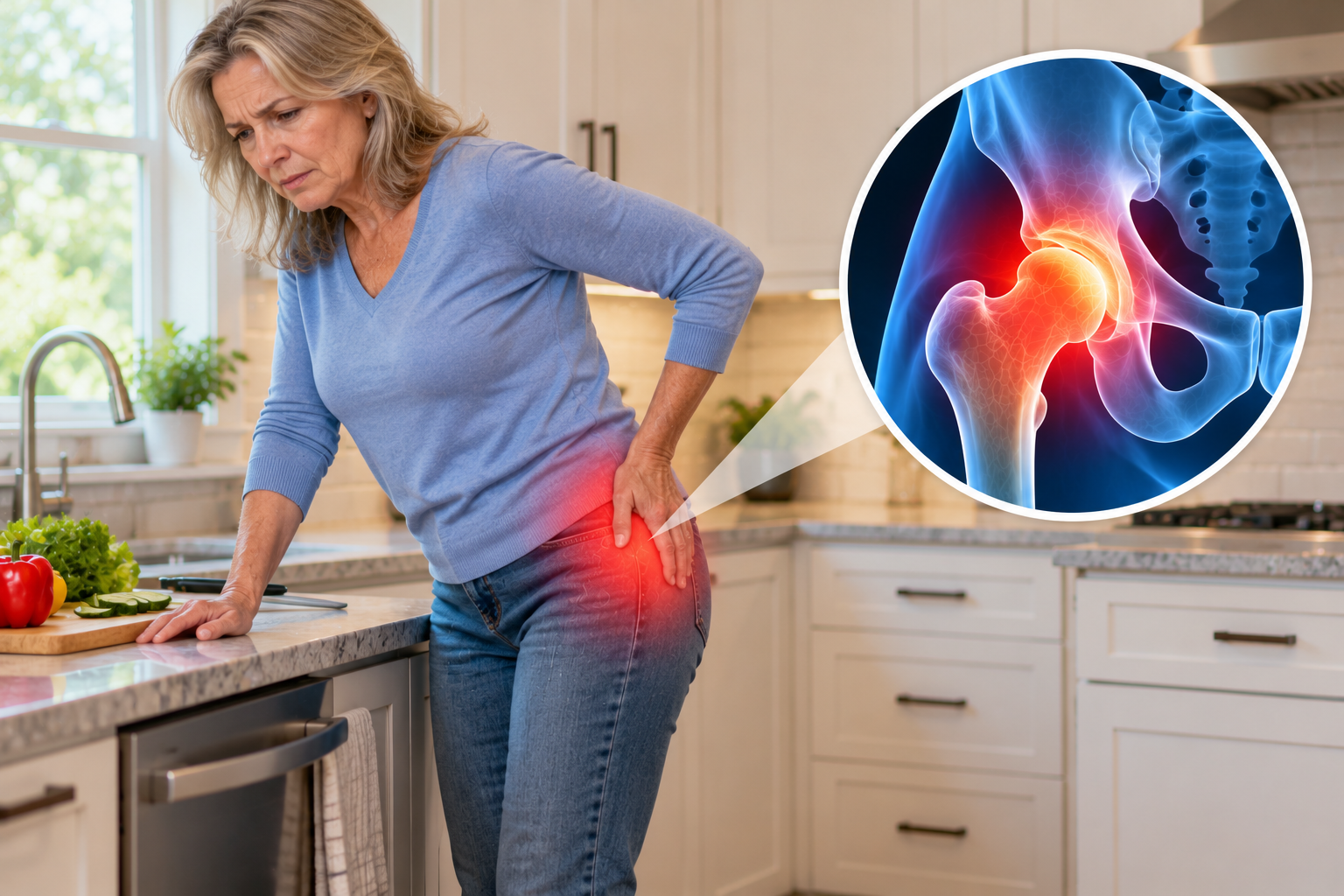
You're standing at the kitchen counter preparing dinner.
Maybe you're chopping vegetables, washing dishes or making a sandwich.
Everything seems fine at first.
But after 10 or 15 minutes, you notice a dull ache developing in your hip.
Perhaps you shift your weight onto the other leg.
Maybe you lean against the counter to take some pressure off.
Or you find yourself looking for a chair because your hip is becoming increasingly uncomfortable.
Sound familiar?
Hip pain during prolonged standing is a common complaint, particularly among adults dealing with arthritis, muscle weakness or chronic joint problems.
And surprisingly, standing still can sometimes be more uncomfortable than walking!
You might assume that walking would place more stress on your hips than standing in one place.
After all, walking involves movement, while standing doesn't seem particularly demanding.
But your hips are still working when you're standing.
Your hip joints support your body weight, while the muscles surrounding your pelvis help maintain balance and posture.
When you remain in one position for an extended period, certain muscles must continue working to keep you upright.
Unlike walking, which alternates muscle activity and changes joint positions, prolonged standing can expose your hips to sustained loading.
For someone with an already irritated hip, that can become uncomfortable.
You might notice:
The location and behavior of your symptoms can provide important clues about what's happening.
Hip osteoarthritis involves changes affecting the cartilage, bone and other structures within the joint.
Over time, these changes can contribute to pain, stiffness and reduced mobility.
People with hip arthritis often experience discomfort in the groin or front of the hip, although pain can also extend into the thigh or buttock.
Prolonged standing may aggravate symptoms because the hip continues supporting your body weight.
You might notice that:
🦴 Your hip becomes uncomfortable after standing for several minutes.
🚶 Walking a short distance sometimes helps loosen things up.
🪑 Sitting provides temporary relief.
🔄 Turning or pivoting at the counter causes a sharper pain.
👟 Putting on shoes and socks has become more difficult.
However, hip pain during standing doesn't automatically mean you have advanced arthritis.
Other structures around the hip can produce similar symptoms.
Your gluteal muscles play an important role in stabilizing your pelvis.
Two particularly important muscles are the gluteus medius and gluteus minimus.
These muscles help control your pelvis when you're standing and walking.
If their tendons become irritated, a condition often described as greater trochanteric pain syndrome can develop.
This condition frequently causes pain along the outside of the hip.
You may notice:
🔴 Tenderness when pressing on the outer hip
🛏️ Pain when lying on the affected side
🚶 Discomfort during walking or stair climbing
⚖️ Pain when standing with most of your weight on one leg
🍳 Aching while standing at the kitchen counter
Interestingly, some people unknowingly make the problem worse by leaning heavily onto one hip while standing.
That position can increase compression around the irritated tendons.
Pay attention to how you stand the next time you're washing dishes.
Are you distributing your weight evenly between both legs?
Or are you leaning onto one hip?
Many people naturally shift most of their weight onto one leg when standing for extended periods.
It may feel comfortable initially.
But repeatedly standing with your hip pushed outward can increase stress on certain structures surrounding the joint.
If those tissues are already sensitive, discomfort may develop.
This doesn't mean you need to stand perfectly straight all day.
In fact, regularly changing positions is often more comfortable than maintaining any single posture for too long.
The goal is to avoid repeatedly loading an already painful hip in the same position.
Here's something many people don't realize:
Pain that feels like it's coming from your hip may actually originate in your lumbar spine.
The nerves supplying your hips and legs originate in your lower back.
Certain spinal conditions can produce pain in the buttock, outer hip or thigh.
One example is lumbar spinal stenosis.
This condition involves narrowing around structures within the spinal canal.
For some individuals, standing upright can aggravate symptoms, while sitting or bending forward provides relief.
You might notice:
If leaning forward onto the kitchen counter consistently relieves your symptoms, that's a useful detail to mention during an evaluation.
It may suggest a spinal contribution rather than an isolated hip-joint problem.
Not every painful hip has significant structural damage.
Sometimes muscle weakness, reduced endurance and altered movement patterns contribute to discomfort.
Your hip muscles must work together to maintain pelvic stability.
When those muscles fatigue, your body may compensate by changing posture or shifting weight.
For example, you may begin:
↔️ Leaning to one side
🦵 Locking one knee
🪑 Resting against the counter
🚶 Taking frequent breaks
😣 Avoiding tasks that require prolonged standing
Appropriate strengthening and movement exercises can improve function for many people with chronic hip problems.
However, the exercises should match the underlying condition.
For example, some exercises that are helpful for hip osteoarthritis may aggravate certain gluteal tendon problems.
That's why identifying the source of your pain matters.
Some people experience an interesting pattern.
They can stand at the counter for 15 minutes and develop hip discomfort.
But when they begin walking around the kitchen, the pain eases.
Movement changes the demands placed on the hip.
Walking alternates muscle activity and moves the joint through different positions.
For some individuals, that variation is more comfortable than remaining stationary.
People with arthritis may also experience temporary improvement in stiffness after gentle movement.
However, not everyone responds the same way.
Some hip conditions become more painful with walking, while others are aggravated primarily by standing.
The pattern helps distinguish possible causes.
The amount of time you can comfortably stand can be useful information.
Perhaps you used to prepare an entire meal without thinking about your hips.
Now you begin shifting your weight after five minutes.
Or maybe you can stand for 20 minutes, but your hip becomes increasingly painful afterward.
A declining tolerance for standing may reflect worsening joint irritation, reduced muscle endurance or another underlying condition.
It doesn't necessarily mean your hip is deteriorating rapidly.
But if everyday activities are becoming progressively more difficult, an evaluation is reasonable.
You don't necessarily have to stop doing the activities you enjoy.
A few adjustments may help reduce discomfort.
1. Change positions regularly.
Avoid standing in exactly the same position for extended periods.
2. Take brief movement breaks.
Walk around the kitchen or sit for a few minutes when symptoms begin.
3. Avoid hanging on one hip.
Try not to place all your weight on one leg for long periods, especially if you have outer-hip pain.
4. Wear comfortable, supportive footwear.
Hard floors and unsupportive shoes may add to discomfort during prolonged standing.
5. Adjust your workspace.
A counter that's too low may encourage excessive forward bending, while one that's too high may create unnecessary postural strain.
6. Consider appropriate strengthening exercises.
Hip and lower-extremity strengthening may improve standing tolerance, depending on the diagnosis.
7. Use a stool for longer tasks.
Sitting during food preparation can help reduce sustained loading when your hip is particularly uncomfortable.
These modifications may help manage symptoms, but they don't replace identifying the cause of persistent pain.
Absolutely not necessarily.
Hip replacement surgery can be an effective treatment for appropriately selected patients with advanced symptomatic hip arthritis.
But experiencing pain while standing at the kitchen counter doesn't automatically mean surgery is required.
Many conditions can produce similar symptoms, including:
Depending on the diagnosis, non-surgical management may include physical therapy, targeted strengthening, activity modification, medications or selected injection-based treatments.
The most appropriate approach depends on the cause and severity of the symptoms.
Consider having your hip evaluated if you're experiencing:
🚩 Increasing pain during prolonged standing
🚩 Difficulty preparing meals or washing dishes
🚩 Persistent groin or outer-hip discomfort
🚩 Pain that interrupts your sleep
🚩 Reduced walking tolerance
🚩 Limping or difficulty bearing weight
🚩 Pain extending down your leg with numbness or tingling
🚩 Symptoms that continue despite reasonable activity modifications
Sudden severe hip pain, inability to bear weight, fever with a painful joint or new significant neurologic symptoms warrant prompt medical attention.
If standing at the kitchen counter causes your hip to ache, there may be more going on than simple fatigue.
Hip arthritis, irritated tendons, muscle weakness and even certain lower-back conditions can contribute.
And while occasional discomfort after a long day isn't unusual, persistent hip pain that interferes with ordinary household activities deserves attention.
At Arthritis & Joint Pain Center, we help appropriate patients with chronic hip pain understand what's contributing to their symptoms and explore non-surgical treatment options, with the goal of reducing pain and improving mobility.
Because something as simple as preparing dinner shouldn't leave you searching for a chair.